
How to mass-assemble, test, and package products using assembly line operations
To mass-produce home appliances, synchronize assembly, test and packaging under an 18-second takt: feed big parts by conveyor, small parts by vibratory bowls; use 6-axis robots for screwing and insertion; consolidate safety, function and energy checks in one 4-in-1 station that auto-diverts failures; pack with unmanned case erectors, baggers, weigh-checkers and robot palletisers; link every station via EtherCAT, log serial-bound data for traceability, and pre-validate the whole flow in a digital twin. Modular 20 m sections and quick-change fixtures let new models swap in within 30 min while FTQ ≥98 % and OEE ≥85 % are maintained.
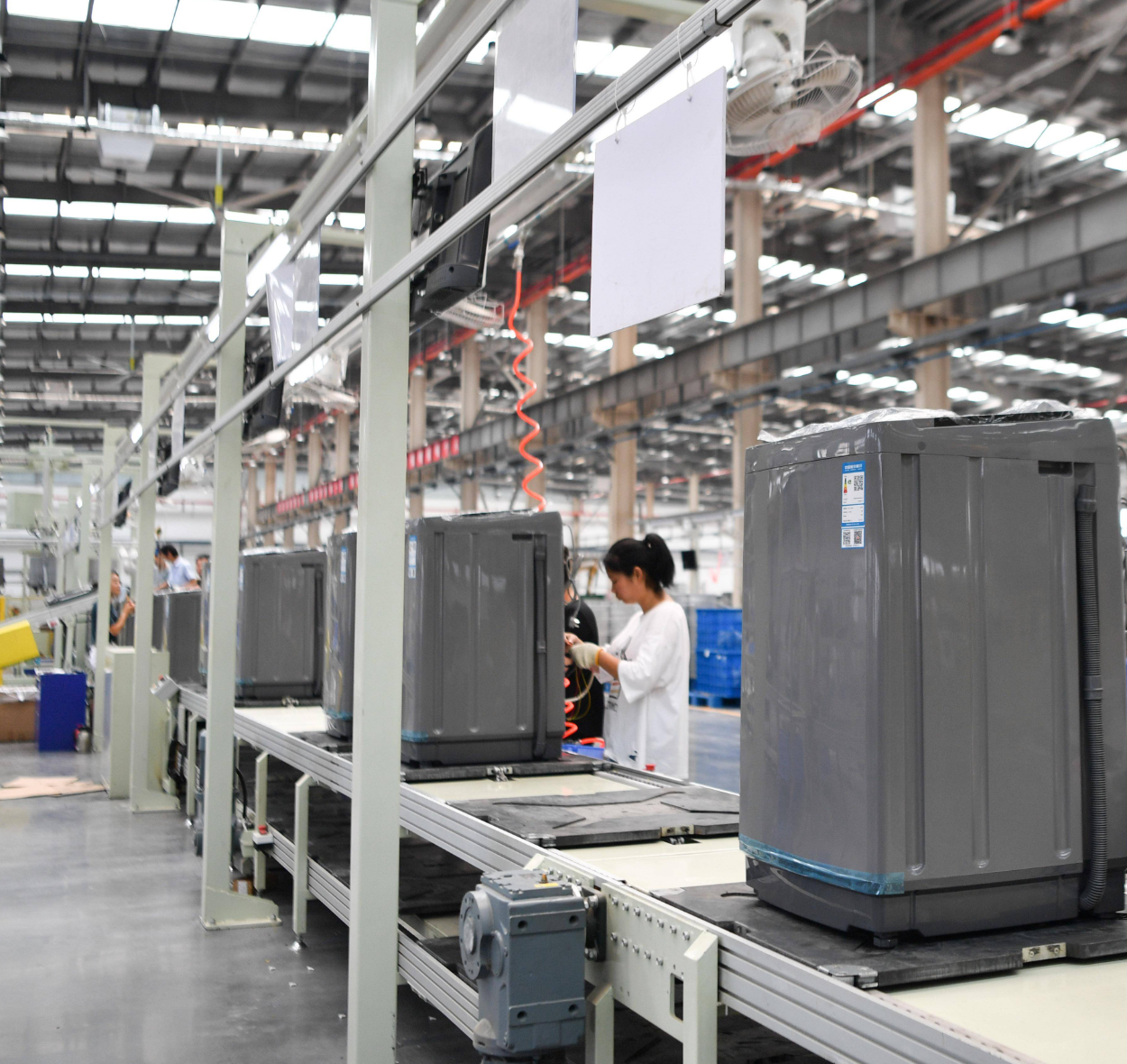
To truly achieve “high-volume assembly + in-line testing + automatic packaging” in one continuous flow, a home-appliance plant must break the line into three sub-systems (assembly, testing, packaging) and link them with three golden rules: identical tact time, seamless data exchange, and rapid change-over. Below is a floor-to-ceiling playbook—planning → assembly → testing → packaging → digitalisation—complete with the equipment, layouts, parameters, quality gates and usual pitfalls that appliance makers hit when they roll it out.
- Macro planning: calculate tact first, pick the conveyor second
1.1 Takt time
Takt = available production time ÷ customer demand.
Example: 4 000 electric kettles/day, two-shift operation 20 h → takt = 18 s. Any station slower than 18 s is a bottleneck.
1.2 Conveyor choice
80 % of appliance plants use “double-speed roller chain + stopper” flexible pallet conveyors because:
- they accumulate—short stoppages don’t stop the whole line;
- 3–30 kg housings are handled economically;
- robots can be added later without major rework.
1.3 Modular cells
Split a 150 m line into 6–8 “20 m standard sections”, 12 stations each. Between sections use lift-transfer units. When the next model arrives, swap or retune two sections only—no need to rebuild the entire line .
- Assembly zone: let man, machine and material meet within 18 s
2.1 Feeding philosophy
- Big parts (housing, inner tank): centre-aligning roller + pop-up transfer → direct to pallet, no manual lift.
- Small parts (screws, washers): vibratory bowl + inline driver → delivered to the nose of the screwdriver; operator only pulls the trigger.
- Critical parts (PCBA, pump): RFID tote; at the moment of loading the serial number is bound to the product for full traceability .
2.2 Manual station design - Working height 850 mm, abdomen clearance ≥450 mm, accommodates 5th–95th percentile seated operators.
- Tool balancers + retractors: pick/place time ≤0.8 s.
- Andon rope at every station; if job can’t be finished within 18 s, pull rope—line keeps moving but system logs the bottleneck.
2.3 Robot islands
Highest ROI robot tasks in appliances:
① automatic screw-driving on housing (6-axis + vision, 0.9 s/screw, repeatability ±0.02 mm);
② compressor/motor insertion (4-axis SCARA + force control, avoids crushing dampers);
③ tamper-label placement (vision-guided servo turret, ±0.5 mm).
40 robots can cut direct labour from 79 to 39 heads .
2.4 Quick change-over
Robot programs, fixtures and feeders use “12-pin standard interface + quick-lock pin”; model change time drops from 4 h to 28 min .
- In-line testing: finish function + safety + performance in one pass
Appliance testing is consolidated into a “4-in-1” station with tact ≤18 s; FAIL parts are automatically diverted to a repair loop.
3.1 Electrical safety
- Hipot 1 500 V / 5 mA / 2 s; ground bond ≤0.1 Ω.
- High-voltage scanner + safety PLC finishes in 1 s.
3.2 Functional test - Custom fixture + analog I/O board powers the unit and checks 5 items: keys, display, load current, sensors, communication.
- Results are written into product Flash; service centres can read them later.
3.3 Performance / energy efficiency - HVAC & refrigeration: evacuate → N₂ charge → 30 s pressure hold → leak ≤30 Pa, replaces water bath, tact 25 s → 18 s .
- Instant water heater: raise outlet ΔT 5 °C within 15 s; power deviation ≤±3 %.
3.4 Noise / vibration - Two microphones in semi-anechoic box, sound pressure ≤38 dB(A).
- Accelerometer sweep 100–2 000 Hz; resonance peak ≤0.5 g.
3.5 Rework loop
Upper conveyor has NG pop-up; failed unit drops to lower return line, re-enters test after repair, forming a closed loop .
- Packaging zone: from bare unit to warehouse-ready pallet, unmanned
Typical appliance pack-line: “case erect → bag → foam → insert unit → insert accessories → seal → label → palletise”, 7 steps, 1–2 patrol operators .
4.1 Case erector
Vertical erector 12 cases/min, hot-melt seal, blank waste ≤1 ‰.
4.2 Bag / cushioning
- Automatic gusset bag, 0.04 mm PE, 15 % film saving.
- Foam blocks fed by gantry + vacuum gripper, 4 blocks in 0.8 s.
4.3 Packing
Robot uses vision + force control to rotate unit 90° into carton, preventing scratches; accessory box delivered by mini-Kiva just-in-time.
4.4 Check-weigh / labelling
In-motion scale ±5 g; overweight/missing-kits automatically rejected; QR label links unit serial to carton.
4.5 Palletising - Robot + servo gripper achieves 5×4×3 stack, 30 kg payload, 12 s/carton.
- RFID tag on pallet; forklift gate reader updates WMS automatically.
- Digital backbone: make every machine speak the same language
5.1 Control architecture
One main PLC + distributed EtherCAT nodes, cutting wiring 30 %.
5.2 Key metrics
Takt attainment, First-Time-Through (FTQ), Overall Equipment Effectiveness (OEE) displayed on Andon in real time.
Test results, material lots, machine parameters bound to serial number, stored ≥5 years for recall compliance.
5.3 Digital twin
Run 72 h virtually before go-live to verify robot paths, buffer sizes, bottlenecks; on-site commissioning time −40 % .
5.4 Flexible scheduling
MES embeds “dynamic sequencing algorithm”, mixes five refrigerator capacities, daily output variation ≤±7 %, still meets e-commerce surges .
- Quick checklist (copy–paste ready)
- Floor: flatness ≤3 mm / 10 m, load ≥1 200 kg/m².
- Utilities: every 10 m one 380 V / 32 A socket, air 0.6 MPa, DN25.
- Safety: robot fence + interlock, light curtain 1.8 m, service door LOTO.
- Training: operators 2 days, techs 5 days, process engineers 7 days, phased exam.
- Acceptance: 3×8 h continuous run, FTQ ≥98 %, OEE ≥85 %, then hand-over.
One-sentence takeaway
A high-volume appliance line = “flexible pallet conveyor + robot islands + 4-in-1 test + auto pack + data traceability” in one plug-and-play package; get the takt math right, slot in modularity, robotics and digitalisation, and you can park a compliant appliance in the warehouse every 18 s—while leaving “hot-swappable” ports for the next model.