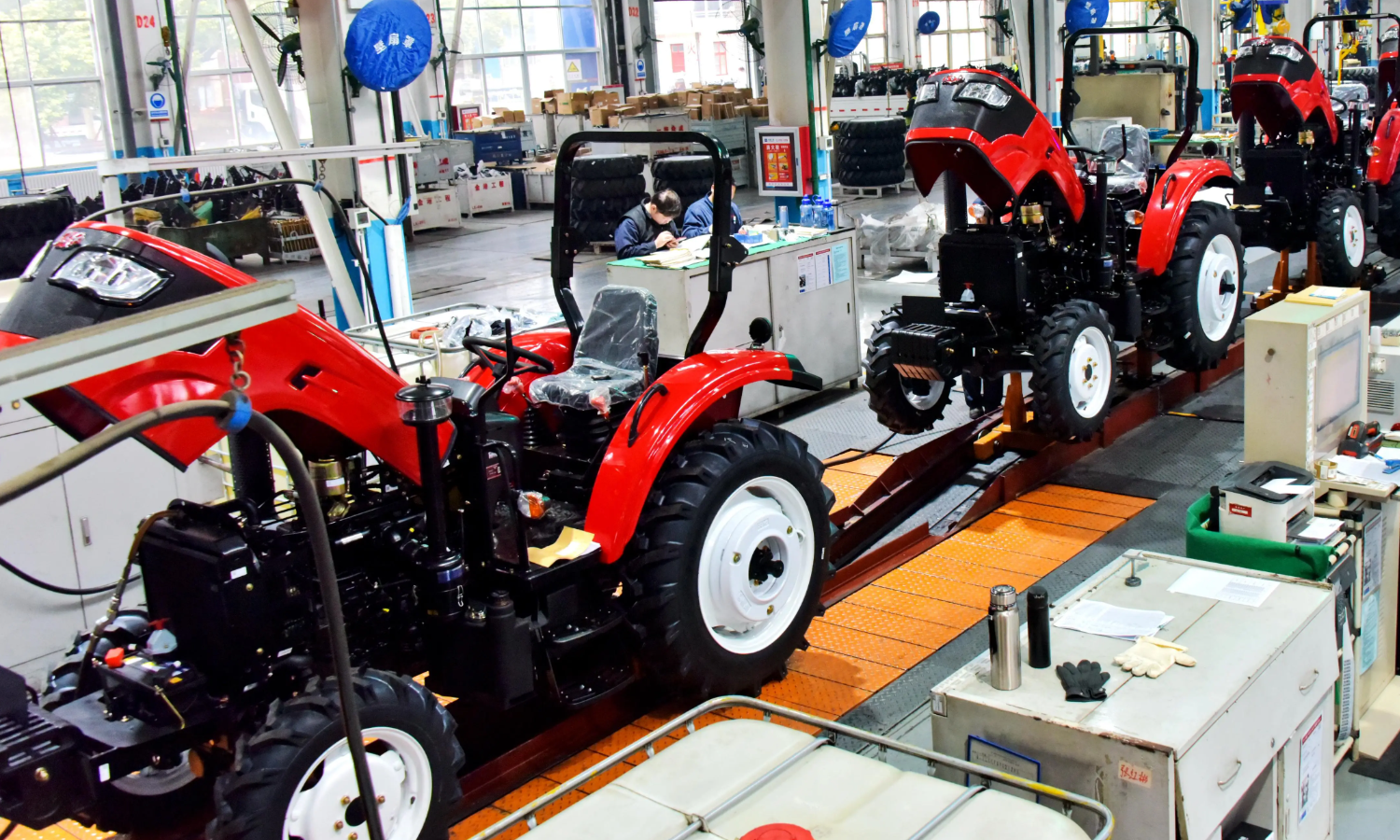
Wheeled tractors, core agricultural machinery with a modular structure centered on power, transmission, traveling, control, hydraulic and suspension systems, feature four-wheel drive for medium and high-power models and two-wheel drive for low-power ones. Their assembly follows the logic of pre-assembly first then final assembly, with core assemblies like engines and gearboxes pre-assembled in dedicated stations before being integrated into the whole machine via a flow-based final assembly line with sequential stations. The assembly process also includes static and dynamic commissioning to eliminate faults, followed by comprehensive ex-factory inspections covering performance, sealing and appearance before warehousing. The dedicated assembly line consists of pre-assembly, final assembly main line, commissioning and inspection, and auxiliary supporting zones, with automation levels and scale tailored to production capacity. Stringent requirements apply to precision control, sealing, torque management and equipment maintenance during assembly, alongside quality control measures such as sampling inspections and traceability systems to ensure production quality and efficiency.
Structure, Assembly Process and Assembly Line Breakdown of Wheeled Tractors
Wheeled tractors are core agricultural machinery equipment, based on wheeled traveling mechanisms and integrated with power, transmission, traveling, control and working device systems. Their assembly adopts a composite process of multi-station flow production + fixed-point assembly for key processes, and the assembly line must meet the assembly requirements of high precision, high rigidity and modularization. The following is a detailed explanation from three aspects: structure, assembly process and assembly line.
I. Core Structure of Wheeled Tractors (Divided by Functional Modules)
The structure of wheeled tractors is designed around the core logic of “power output – transmission and speed change – traveling execution – control and operation – operation adaptation”. Mainstream medium and high power wheeled tractors (50-200 hp) adopt a four-wheel structure (front axle steering + rear axle drive), while low power ones (≤30 hp) are mostly two-wheel drive. The core modules and key components are as follows:
1. Power System
Known as the “heart” of the tractor, it provides power for the operation and work of the whole machine. The core components include diesel engine (including cylinder block, crankshaft, piston, fuel injection system, cooling system, lubrication system), engine base, muffler, air filter, battery and starter motor.
2. Transmission System
As the “bridge” for power transmission, it realizes speed change, torque change and direction change of power, and is the module with the highest assembly precision requirements. The core components include clutch (dry/wet), gearbox (gear type/stepless CVT), drive shaft, differential, rear axle housing and final drive device (half shaft, planetary gear).
3. Traveling System
It supports the movement of the whole machine and field operations, divided into drive axle (rear axle) and steering axle (front axle). The core components include front axle housing, steering knuckle, wheel hub, tires (narrow front and wide rear, adapted to field grip), suspension device (front suspension shock absorption/rear suspension three-point suspension) and braking system (brake pad, brake drum, brake pipeline).
4. Control and Operation System
It realizes the operation and working condition adjustment of the whole machine. The core components include steering wheel, steering gear, hydraulic power steering system, control levers (gear shift lever, clutch pedal, brake pedal, accelerator pedal), hydraulic control system (hydraulic pump, hydraulic cylinder, distributor, adapted to farm tool lifting) and instrument panel (rotational speed, oil pressure, water temperature, gear display).
5. Body and Auxiliary Systems
It ensures the protection, operation comfort and operation adaptability of the whole machine. The core components include frame (welded/integral), cab (equipped with seat, door, windshield, standard for high-power models), oil tank, hydraulic oil tank, traction device (rear traction hook) and power take-off (PTO, connected to rotary tiller, seeder and other farm tools).
6. Hydraulic and Suspension System
As the core execution module for agricultural operations, it realizes the lifting, leveling and traction of farm tools. The core components include hydraulic pump, hydraulic pipeline, distributor, lifter, top link, lower link and limit rod (standard for three-point suspension).
Core structural characteristics: High modularization, the three core modules of power, transmission and traveling are independent assemblies that can be pre-assembled before final assembly; the key mating surfaces (such as gearbox gears, drive shaft splines, bearing seats) are high-precision machined surfaces, and the clearance must be strictly controlled during assembly.
II. Assembly Process of Wheeled Tractors (Focus on Final Assembly, Including Pre-assembly and Commissioning)
The assembly of wheeled tractors follows the principles of “pre-assembly first, then final assembly; core components first, then auxiliary ones; lower parts first, then upper ones; mechanical parts first, then hydraulic/electrical parts”. The final assembly of mainstream medium and high power models adopts flow production, divided into four stages: pre-assembly process, final assembly main line process, commissioning process, inspection and warehousing process. The pre-assembly process of low power models can be appropriately simplified, and some stations can be merged.
Stage 1: Pre-assembly Process (Core Assemblies Assembled in Advance to Reduce the Complexity of the Final Assembly Line)
Pre-assembly is a pre-process of final assembly, in which independent functional modules are assembled into qualified assemblies in special stations in advance, avoiding low efficiency caused by simultaneous assembly of multiple components on the final assembly line. The core pre-assembly contents include:
- Engine assembly pre-assembly: Complete the assembly of the engine cylinder block with the cooling system, lubrication system and fuel system, commission the connection of the starter motor and battery, and conduct engine cold test (no-load test to check whether the rotational speed, oil pressure and water temperature are normal).
- Gearbox-rear axle assembly pre-assembly: A core high-precision pre-assembly process, completed in a dust-free and constant temperature station: press-fitting of gearbox gears and bearings, differential assembly, connection of half shafts and final drive devices, docking of the rear axle housing and gearbox (bolt fastening + sealant sealing to prevent oil leakage), and conduct no-load test run of the gearbox after completion (check smooth gear shifting, no jamming and no abnormal noise).
- Front axle assembly pre-assembly: Complete the assembly of the front axle housing with the steering knuckle, wheel hub and braking system, connection of the hydraulic power steering pump and the front axle, and test run of the steering knuckle (check flexible steering without jamming).
- Hydraulic-suspension system pre-assembly: Complete the pipeline connection of the hydraulic pump, hydraulic cylinder and distributor, assembly of the lifter and pull rods, and conduct hydraulic pressure holding test (check no pipeline leakage and pressure reaching the rated value).
- Cab assembly pre-assembly: Complete the assembly of seats, steering wheel, instrument panel, control levers and doors in the cab, lay the internal electrical wiring, and commission the display function of the instrument panel.
Key pre-assembly requirements: All pre-assembled assemblies must pass first article inspection + sampling inspection before being transferred to the final assembly line; high-precision mating components (such as bearings, splines) must be coated with special lubricating grease (such as lithium-based grease) before assembly, and dry assembly is prohibited; sealing parts (such as housing joint surfaces, pipeline joints) must be coated with sealant or installed with sealing rings as required to prevent oil, air and liquid leakage.
Stage 2: Final Assembly Main Line Process (Flow Production, Key Stations Connected in Sequence)
The final assembly main line is the core link of tractor assembly, adopting ground plate conveyor line/air hoist conveyor line to splice the pre-assembled qualified assemblies into the whole machine in the order of stations. Each station has a fixed operation time (rhythmic production). The final assembly main line of mainstream medium and high power models is equipped with 8-12 core stations, which are automatically transferred by the conveyor line between stations, with manual operation coordinated with special tooling. The core stations and operation contents (in assembly order) are:
- Frame positioning station: Fix the integral/welded frame on the final assembly tooling table, adjust the levelness (datum requirement to avoid assembly deviation in the follow-up), and install the fixed bracket of the engine base.
- Power assembly hoisting station: Hoist the pre-assembled qualified engine assembly to the engine base of the frame with a special hoist, fasten the bolts, and complete the rigid connection between the engine and the frame.
- Transmission assembly docking station: Hoist the gearbox-rear axle assembly to the rear of the frame, complete the docking of the engine flywheel and clutch (a core mating station), connect the drive shaft to the engine and gearbox, and fasten the spline bolts at both ends.
- Traveling system assembly station: ① Hoist the front axle assembly to the front of the frame, complete the connection between the front axle and the frame, and install the front wheel hub and front tires; ② Install the rear wheel hub and rear tires on the rear axle half shafts; ③ Install the brake pipelines and connect the brake pedal with the braking system.
- Hydraulic-suspension system assembly station: Hoist the pre-assembled hydraulic-suspension assembly to the middle/rear of the frame, complete the power connection between the hydraulic pump and the engine, dock the hydraulic pipelines with the gearbox and lifter, install the top link and lower link of the three-point suspension, and fasten the traction hook.
- Electrical system assembly station: Lay the electrical wiring of the whole machine, connect the positive and negative poles of the battery, install the air filter and muffler, and connect the accelerator line with the engine throttle valve.
- Cab hoisting station: Hoist the pre-assembled qualified cab to the upper part of the frame with a special hoist, complete the bolt fastening between the cab and the frame, connect the cab control levers with the transmission mechanism of the steering gear and gearbox, and dock the cab electrical wiring with the whole machine wiring.
- Auxiliary component assembly station: Install the oil tanks and connect the pipelines, install the operating accessories such as vehicle lights, rearview mirrors and armrests, fill with fuel, lubricating oil, hydraulic oil and coolant, and check that all pipelines are free of winding and extrusion.
- Whole machine fastening and re-inspection station: Re-inspect all bolts and nuts, touch up the missing sealant, replace the damaged sealing rings, sort out the wiring and pipelines, and ensure the neat appearance of the whole machine.
Key requirements for the final assembly main line: All assembly operations must follow the process card requirements; bolt tightening adopts torque wrenches; real-name traceability of operators is implemented for key stations; avoid component collision during assembly, and protect the high-precision surfaces well.
Stage 3: Commissioning Process (Static/Dynamic Commissioning of the Whole Machine to Eliminate Assembly Faults)
After the completion of final assembly, the whole machine enters the commissioning process, which is divided into static commissioning and dynamic commissioning to ensure the normal operation of all systems and no assembly faults. The core commissioning contents are:
- Static commissioning: Without starting the engine, check: ① Control system: flexible steering of the steering wheel without jamming, the stroke of the clutch/brake pedal meeting the requirements, smooth gear shifting and clear gears of the gear shift lever; ② Hydraulic suspension: stable lifting of the lifter, accurate positioning of the farm tool suspension points, and no hydraulic pressure holding leakage; ③ Electrical system: normal display of the instrument panel, normal operation of vehicle lights and starter motor, and no short circuit or open circuit of the wiring.
- Dynamic commissioning: Start the engine and conduct no-load test run and light-load test run to detect: ① Power system: stable engine speed, no abnormal noise and oil leakage, oil pressure and water temperature within the rated range; ② Transmission system: normal operation of all gearbox gears, no jitter of the drive shaft, no abnormal noise of the rear axle, effective braking and no deviation of the braking system; ③ Traveling system: flexible in-situ steering, no deviation in straight-line driving, no swing of tires; ④ Hydraulic system: stable lifting of the lifter under full load, pressure reaching the rated value, no leakage.
- Fault elimination: Conduct on-site maintenance for the problems found during commissioning, and re-commission after maintenance until qualified.
Stage 4: Inspection and Warehousing Process (Comprehensive Inspection + Qualified Warehousing to Ensure Ex-factory Quality)
After passing the commissioning, the whole machine enters the inspection and warehousing process for comprehensive ex-factory inspection. After passing the inspection, paste the qualified mark and put it into the warehouse for sale. The core inspection contents are:
- Performance inspection: Detect the key performance indicators of the whole machine to meet the national agricultural machinery standards.
- Sealing performance inspection: Conduct a rain test on the whole machine to check that the cab, engine, gearbox and hydraulic pipelines are free of water inflow, oil leakage and liquid leakage.
- Appearance inspection: Check that the paint surface of the whole machine is free of scratches and paint peeling, the components are installed neatly, the wiring and pipelines are not exposed, and the marks are clear and complete.
- Warehousing: The qualified whole machines are transferred to the finished product warehouse by forklifts, placed by model and power, and well protected against moisture and collision.
III. Assembly Line Breakdown of Wheeled Tractors
The assembly line of wheeled tractors is a special composite assembly line, combining flow final assembly line, fixed pre-assembly stations, commissioning and inspection zone, and auxiliary supporting zone. It must adapt to the modular assembly and high-precision requirements of tractors, and meet the efficiency requirements of mass production at the same time. The assembly line of mainstream large and medium-sized agricultural machinery production enterprises features moderate automation + manual precise operation, and small-batch production enterprises can adopt a semi-flow assembly line. The following is a breakdown of the assembly line by functional zones, including the equipment, functions and technical requirements of each zone:
1. Pre-assembly Zone (Fixed Stations, Non-flow Production)
Core Function
Complete the pre-assembly of core assemblies such as engine, gearbox-rear axle, front axle, hydraulic-suspension and cab to provide qualified assemblies for the final assembly line.
Layout and Equipment
- Layout: Independent of the final assembly main line, equipped with 5-6 special pre-assembly stations according to the assembly type, with a semi-finished product transfer channel between stations;
- Key equipment: Special assembly tooling tables, torque wrenches, hydraulic bearing press-fitting machines, engine cold test benches, gearbox and front axle no-load test run machines, hydraulic pressure holding test benches.
Technical Requirements
- High-precision pre-assembly stations must meet the requirements of dust-free and constant temperature to avoid mating precision deviation caused by dust and temperature changes;
- All pre-assembly equipment must be calibrated regularly.
2. Final Assembly Main Line Zone (Flow Production, Core Assembly Area)
Core Function
Splice the pre-assembled qualified assemblies into the whole machine in the order of stations to realize rhythmic production.
Layout and Equipment
- Layout: Linear layout, with 8-12 core assembly stations, the spacing between stations is 3-5m, equipped with station tool racks;
- Key conveying equipment: Ground plate conveyor line, electric air hoists;
- Auxiliary equipment: Torque wrenches, pneumatic tools, quantitative lubricating grease injectors, quantitative sealant applicators, special tooling for pipeline docking.
Technical Requirements
- The conveyor line has a small levelness deviation to ensure the datum precision of frame assembly;
- Air hoists are equipped with anti-falling devices, and a special person is assigned to direct the hoisting of heavy assemblies;
- Rhythmic production is implemented in each station to avoid accumulation between stations.
3. Commissioning and Inspection Zone (Independent Zone, Including Static/Dynamic Commissioning and Ex-factory Inspection)
Core Function
Complete the static/dynamic commissioning of the whole machine, comprehensive ex-factory performance inspection and sealing performance inspection, and eliminate assembly faults.
Layout and Equipment
- Layout: Divided into static commissioning zone, dynamic commissioning zone, performance inspection zone and rain test zone, each zone is independently separated, and the dynamic commissioning zone is equipped with a test run track;
- Key equipment: Static commissioning tooling tables, engine start commissioning benches, hydraulic system test benches, braking performance testers, steering performance testers, portable detection meters, rain test rooms, automatic comprehensive performance inspection benches.
Technical Requirements
- The dynamic commissioning zone is equipped with good sound insulation protection and exhaust gas collection devices to avoid environmental pollution;
- The rain test room has good sealing performance to avoid water overflow, and the whole machine must be dried in time after the test to prevent rust;
- All testing equipment must be calibrated regularly according to national agricultural machinery standards, and the test data is recorded in real time for traceability.
4. Auxiliary Supporting Zone (Provide Support for the Assembly Line to Ensure Continuous Production)
Core Function
Provide supporting services such as component storage, transfer, tool management and waste recycling to ensure the continuous production of the final assembly line and pre-assembly zone.
Sub-zones and Equipment
- Component temporary storage zone: Store purchased parts and pre-assembled semi-finished products, equipped with shelves, forklifts and pallets, implementing the first-in first-out management;
- Tool management zone: Store assembly tools, equipped with tool cabinets and tool calibration benches, implementing the real-name collection/return of tools;
- Oil filling zone: Store fuel, lubricating oil, hydraulic oil and coolant, equipped with quantitative injectors to implement quantitative filling and avoid waste;
- Waste recycling zone: Store waste products and waste materials generated during assembly, conduct classified recycling and environmental protection treatment;
- Maintenance zone: Provide maintenance for faulty whole machines found during commissioning and inspection, equipped with special maintenance tooling and tools, and re-inspect after maintenance.
5. Key Technical Parameters and Capacity Adaptation of the Assembly Line
The parameters of the wheeled tractor assembly line are designed according to the production capacity and product model. The core parameters of the assembly line of mainstream large and medium-sized agricultural machinery enterprises are as follows:
| Assembly Line Type | Adapted Capacity (Units/Day) | Length of Final Assembly Line (m) | Number of Core Stations | Assembly Working Hours per Unit (h/Unit) | Automation Level |
|---|---|---|---|---|---|
| Large flow assembly line | 80-120 | 100-150 | 10-12 | 4-6 | Moderate (automated conveying and hoisting, manual assembly) |
| Medium flow assembly line | 30-80 | 60-100 | 8-10 | 6-8 | Low (semi-automated conveying, manual assembly) |
| Semi-flow assembly line | 10-30 | 30-60 | 5-8 | 8-12 | Manual (manual conveying, manual assembly) |
6. Quality Control Requirements of the Assembly Line
- First article inspection: The first whole machine produced in each shift must undergo a full-process inspection, and mass production can only be carried out after passing the inspection;
- Sampling inspection: Sampling inspection is conducted on pre-assembled assemblies and the final assembled whole machines;
- Traceability system: Two-dimensional codes are pasted on key components to record the production batch, assembly personnel and test data to realize full life cycle traceability;
- On-site management: Follow the 5S management principles, with station tools placed neatly and wiring and pipelines sorted out standardly to avoid assembly errors caused by on-site disorder.
IV. Key Notes for Assembly and Assembly Line
- High-precision mating components: Clean high-precision mating components such as bearings, splines and gears before assembly, coat with special lubricating grease, and prohibit dry assembly or use of unqualified lubricating grease;
- Torque control: Tighten all bolts and nuts as required, and implement double re-inspection for key stations to prevent loosening due to insufficient torque or thread slipping due to excessive torque;
- Sealing protection: Ensure good sealing for all housing joint surfaces, pipeline joints and bearing seats, apply sealant evenly and install sealing rings in place to avoid oil, air and liquid leakage;
- Electrical safety: Ensure firm connection of electrical wiring, avoid reverse connection of positive and negative poles, and do a good job of insulation protection for wire harnesses to prevent electrical faults caused by short circuit and open circuit;
- Equipment maintenance: Conduct regular maintenance on the conveying equipment, hoisting equipment and testing equipment of the assembly line, and replace vulnerable parts in a timely manner to ensure the normal operation of the equipment;
- Personnel training: Assembly operators must receive professional training and take up their posts with certificates, and skilled technicians are required to operate high-precision stations.