Autonomous Vehicle Structure and Assembly Line System
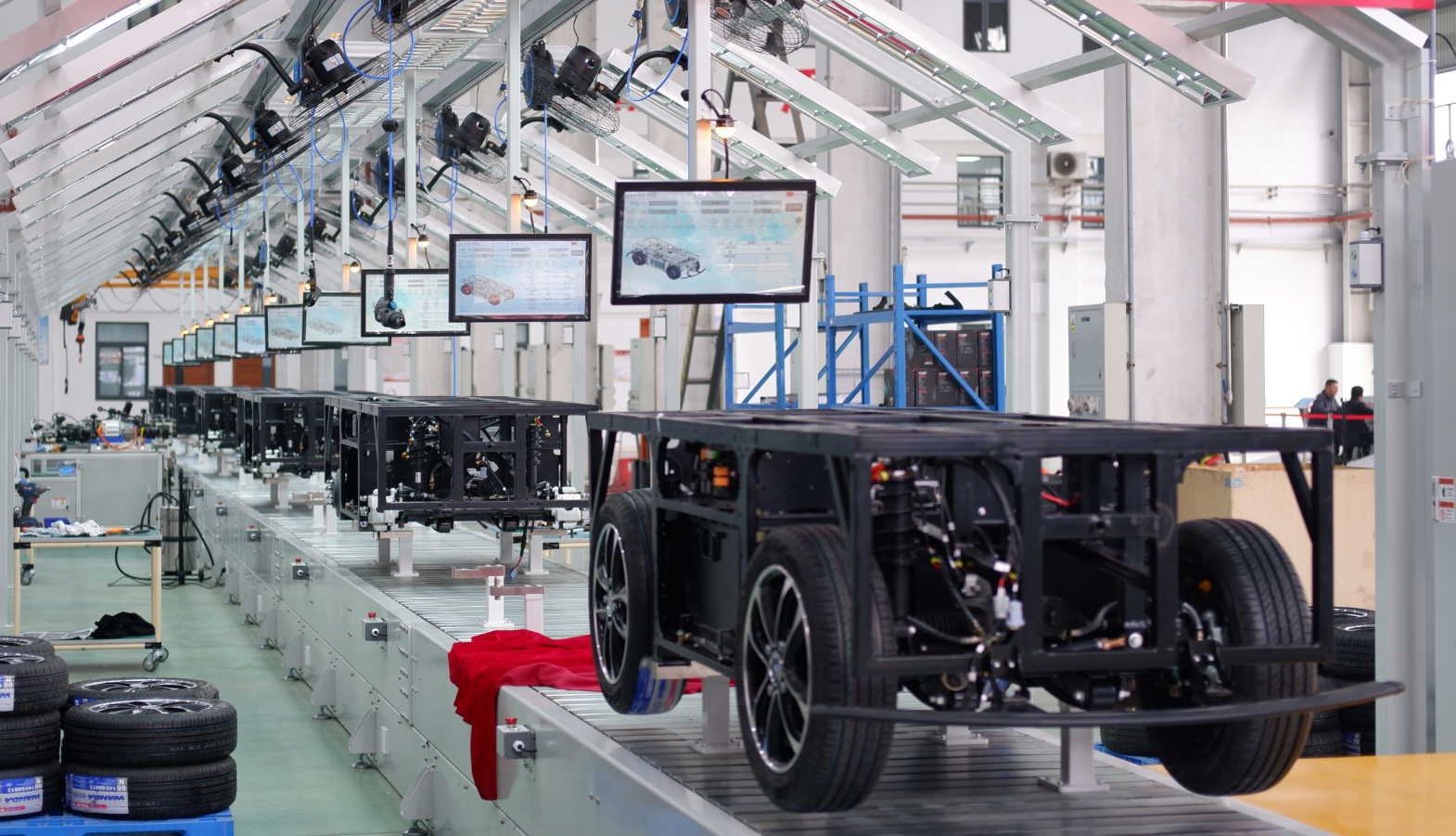
The autonomous vehicle architecture merges seven core modules—skid-chassis, by-wire drivetrain, swappable battery, domain controllers, multi-sensor array, sealed harness and snap-fit panels—into one IP67-grade rolling platform. A 12-step takt-balanced assembly line rivets, fastens and hot-plugs these modules in 90 s while software flashes in parallel. Inline testing applies 18-item spec: HV safety, sensor calibration, vehicle dynamics and L4 functions, all data-logged for AI-driven quality loops. Shared fixtures, 3-D printed sensor brackets and simultaneous operations cut tooling 25 % and boost yearly output to 50 k units within 12 months.
Autonomous Vehicle Structure, Assembly & Test Process Flow, and Production Line System
- Vehicle Structure – “7+1” Building Blocks
- Skid-chassis hybrid frame (aluminum extrusion / high-strength steel, welded or riveted)
- Four-wheel steering + braking + hydraulic/electric actuation (motor, reducer, knuckle)
- Battery-pack housing & swap-lock mechanism (IP67 sealed, bottom crash rail)
- Domain-controller bracket & thermal air duct (XCU, PDU, DC-DC stacked)
- Multi-sensor bracket array (front cross-bar 3 cameras + LiDAR, rear cross-bar 4D mmWave, corner radars)
- Wiring & Ethernet “fish-bone” trough (segmented corrugated tubes, ≤3 bulkhead connectors)
- Interior/exterior snap-fit panels (no cockpit, dash converted to service-friendly module)
- By-wire redundant interfaces (dual CAN-FD + FlexRay, OTA rollback-ready)
- 12-Step Assembly Sequence (with takt-time)
0 Pre-check: incoming scan-photo-AI compare (≤30 s)
1 Sub-frame & chassis marriage: sub-frame press-in + brake pipe pre-torque (takt 55 s)
2 Battery insert: AGV lifts → auto-lock 8 bolts (120 N·m ±3 %)
3 Motor/reducer pre-assembly: 3 dowels + 12 flange bolts in one shot (takt 45 s)
4 Four-wheel steering: rack preload 0.15 mm, laser back-lash check (takt 50 s)
5 Body frame riveting: 7-axis robot 24 lock-bolts, pull force 28 kN monitored (takt 60 s)
6 Domain controller & harness: bottom-first “drawer” slide, hot-plug ≤15 s
7 Sensor bracket array: laser alignment + vision-guided fastening, planarity ≤0.3 mm (takt 70 s)
8 Exterior clips: ultrasonic weld + sealant bead 3 mm ±0.2 mm (takt 40 s)
9 Fill & first power-on: coolant 6 L, brake fluid 0.8 L, refrigerant 0.65 kg (takt 35 s)
10 Software flashing: parallel write to 4 domains, 28 min (overlapped with off-line ops)
11 Pre-calibration self-test: insulation, equipotential, leak, HVIL (≤3 min)
12 To calibration: skid conveyor → turntable, takt 90 s, 320 units/shift (8 h) - 4-Layer / 18-Item Test Spec
L1 Electrical (4 items)
① HV insulation >500 MΩ
② Equipotential <0.1 Ω
③ LV quiescent current <3 mA
④ Software CRC check
L2 Sensor Calibration (5 items)
⑤ Camera intrinsics + distortion (checkerboard 0.05 px)
⑥ LiDAR extrinsics (plane-fit σ≤3 mm)
⑦ mmWave RCS calib. (–8 dBsm metal sphere)
⑧ IMU bias stability <3 °/h
⑨ Surround-view stitch error <5 mm
L3 Vehicle Performance (5 items)
⑩ Max lateral acceleration 0.6 g
⑪ Braking 50 km/h → 0 ≤13 m
⑫ Min turning diameter ≤10 m
⑬ Top speed 60 km/h continuous 30 min
⑭ NEDC range ≥350 km
L4 Autonomous Functions (4 items)
⑮ Traffic-light recognition ≥99.5 %
⑯ Pedestrian AEB pass @ 60 km/h
⑰ Lane-keeping lateral error ≤0.2 m
⑱ OTA rollback success 100 %
- Mass-Production Line System (AutoX Changzhou plant benchmark)
Logistics
- AS/RS + AGV “tidal” supply, empty totes auto-return; picking error <50 ppm
- Key parts RFID end-to-end for full-life traceability
Sub-assembly island
- Dual-main sensor fusion module, corner module, XCU cold-plate assembled off-line; robot fastening, MES pushes parameters
Main line
- 128 m semi-auto skid line (ABB 7-axis) + 4-section overhead; mixed-model takt 90 s
- Operator screen shows live torque, pressure, photo result; auto line-stop on NOK
Calibration / End-of-Line
- Indoor turntable: 4-wheel alignment + camera pitch/roll in one shot, error ≤0.02°
- Soak chamber (45 °C 30 min) → rain tunnel (IPX5 15 min) continuous; saves 40 % takt
- PDI 120-item checklist auto-compared; e-Certificate auto-generated
Data closed-loop
- 1.2 GB process data per car uploaded; AI quality model warns real-time; 3-month replay recall possible
- Implementation Tips
- Share “small-three-electric” & by-wire chassis platform for B2B/B2C bodies; cuts tooling 25 %.
- Use “aluminum extrusion + 3-D printed joints” for sensor brackets; structure change in 3 days.
- Share indoor turntable + roller-bench first; add 1 km closed road later for L4 homologation.
- Run software flashing, HV tests & interior ops in parallel; reduce main-line takt from 120 s to 90 s and boost yearly capacity 30 %.
With the above 7 structural modules, 12-step assembly, 18-item test spec and 4-layer production system, a 50 k-units/year L4 autonomous-vehicle flexible line—meeting automotive-grade quality and regulatory admission—can be built within 12 months.