
Why use conveyor lines to assist assembly?
Conveyor-assisted assembly converts idle handling time into productive work, lifting home-appliance output by 50 % and engine-line utilisation to 95 %. Accurate positioning and RFID pallets cut defects and mix-ups to near zero while saving 30 % floor space and 65 % manual-handling injuries. Modular rollers and magnetically driven tracks allow model change-overs in minutes and mixed-model production without hardware swaps. Energy-regenerative systems and lower maintenance yield 20–30 % five-year cost savings. Thus conveyors have evolved from simple transport to a core process enabler of efficient, flexible, safe and high-quality manufacturing in automotive and appliance plants.
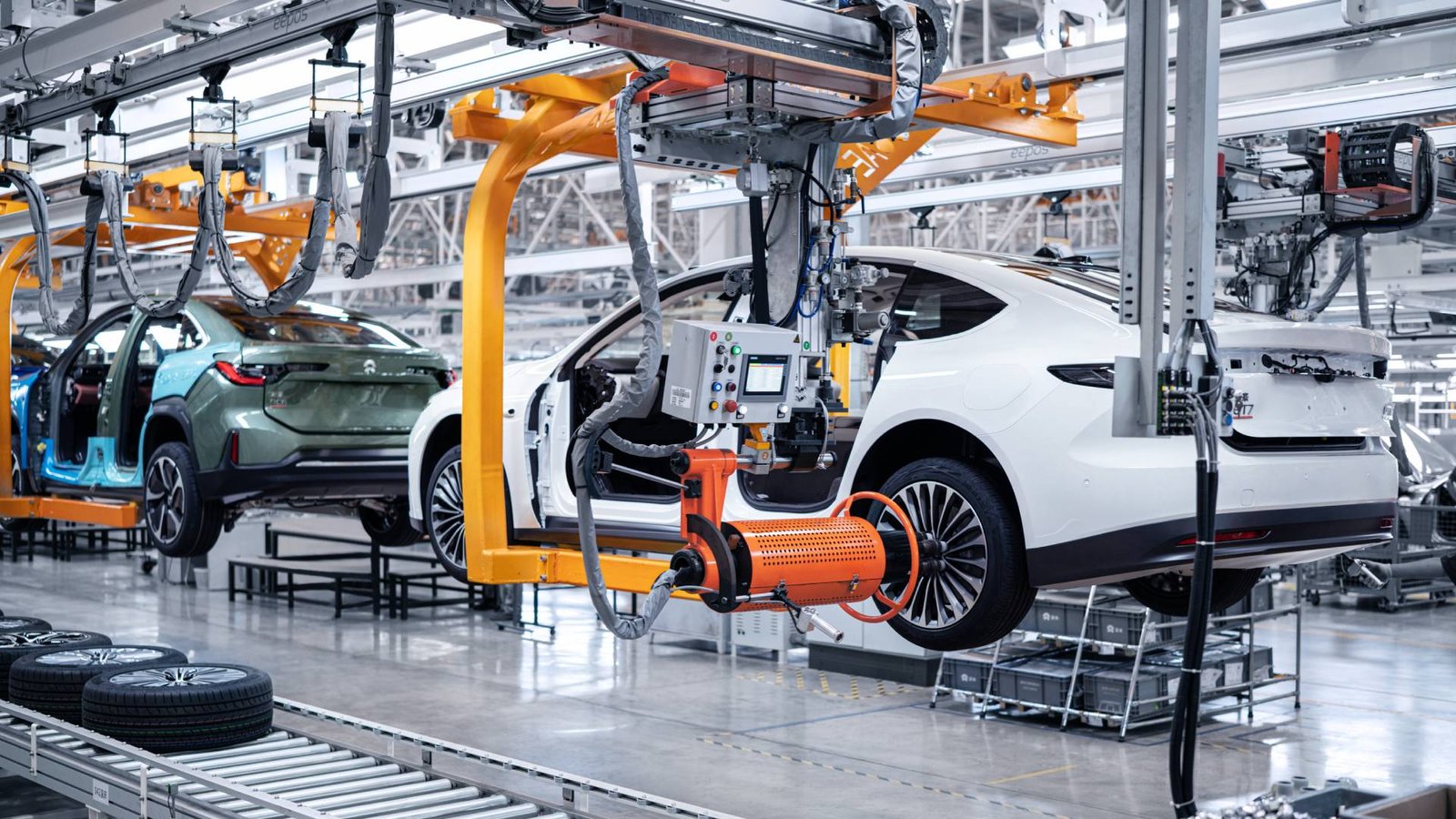
Why Use Conveyors to Assist Assembly?
A Detailed Analysis Based on Home-Appliance and Automotive Plants
Conveyor-assisted assembly has become the “underlying logic” of discrete manufacturing in industries such as home appliances and automobiles. Its necessity can be decomposed into five dimensions—efficiency, quality, cost, flexibility and safety—illustrated with typical shop-floor data.
- Efficiency: convert “handling time” into “value-adding time”
a. Continuous flow eliminates station waiting.
A hybrid roller + double-speed chain line in a home-appliance plant feeds nine part families (inner tank, compressor, PCB, etc.) to 11 stations at 6 s per unit, raising shift output from 400 to 650 units.
b. High-speed accumulation creates dynamic buffers.
An engine-assembly line uses 4 000 kg-capacity double-speed chains; cylinder blocks can accumulate anywhere, lifting line utilisation from 75 % to 95 % and cutting change-over losses by 30 %.
c. Space-for-time layout shortens travel.
A 120 m straight line is folded into a 38 m S-shaped roller conveyor, saving 30 % floor space and 42 % logistic distance. - Quality: turn “transport” into “error-proofing”
a. ±1 mm accurate positioning.
Servo-driven rollers give 0.5 mm repeatability at a gearbox marriage station; bolt first-time tightening OK-rate rises from 92 % to 99.5 %.
b. Pallet ID tracking drives zero-mix.
An EV battery line with RFID pallets identifies eight cell variants; 18 months of mixed production recorded zero part-mix.
c. Gentle handling cuts cosmetic defects.
Roller surface speed differential <1 % reduces air-conditioner shell scratches from 2 % to 0.3 %. - Cost: replace “manual handling” with “equipment depreciation”
a. Head-count reduction.
A 30-station appliance line formerly needed 58 porters; after conveyorisation eight attendants suffice, saving ≈ USD 260 k per year.
b. Energy recovery.
Magnetically driven conveyors regenerate 20–30 % of braking energy; four car-trim lines save 340 MWh annually.
c. Lower total cost of ownership.
Over five years roller lines cost 20–30 % less than slat conveyors (including maintenance, energy, downtime), shortening pay-back by 18 months. - Flexibility: make “rigid flow lines” reconfigurable
a. Modular plug-and-play segments.
Double-speed and roller modules clip together; a door line model change-over drops from two shifts (16 h) to 45 min.
b. Parameter-only adaptation.
Mag-drive lines alter speed and acceleration profiles in software, supporting three e-motor variants on one track with no mechanical change.
c. Mixed-model production.
Seventeen washer/dryer variants share one conveyor; pallet ID + vision keep mixed takt at 9 s per unit. - Safety & EHS: lock “handling hazards” into the system
a. 65 % drop in manual-handling injuries after roller conveyors were introduced in a final-assembly hall.
b. IP69K rollers operate inside paint booths (60 °C, 85 % RH, solvents), cutting worker VOC exposure by 90 %.
c. Airport-spec rollers keep noise <65 dB, trimming interior-trim line sound level by 20 dB (8 h LEQ <80 dB).
Typical integrated solutions
Home appliance “three-stage” line: double-speed (heavy accumulation) → roller (high-speed diverting) → belt (precise packaging), 6 s takt, <30 min change-over.
Automotive “skillet” line: body on roller + skid moves while operators fit engine, seats and IP; station time 52 s, equipment utilisation 95 %.
EV battery flexible line: mag-drive + RFID + AGV feeding, eight pack variants, 30 JPH, capacity scaled by simply lengthening track.
Conclusion
Conveyors do not only “move faster”; by adding accuracy, traceability, buffering and re-configurability they embed the transport function inside the process itself, becoming an amplifier of both quality and productivity. For high-mix, fast-takt, quality-critical discrete manufacturing, conveyors have evolved from “auxiliary equipment” to “process equipment” and now form the physical backbone of digital and flexible factories.