Tractor structure, assembly process, and production line system
Tractors consist of eight core systems, including power, transmission, traveling, steering, braking, hydraulic, electrical systems, and working devices, which collaborate to realize power output, driving control, and operational functions. Their assembly follows the process of sub-assembly pre-installation, final assembly, and commissioning testing, ensuring precise component matching and reliable performance. The assembly line adopts a modular, automated, and flexible design with a U-shaped layout, supported by specialized equipment and an MES system. This setup enables efficient, accurate mass production, with strict quality checks at each stage to guarantee the stable performance of every tractor.
I. Core Structure of Tractors
A tractor is mainly composed of eight core systems: power system, transmission system, traveling system, steering system, braking system, hydraulic system, electrical system, and working device. These systems work together to achieve power output, driving control, and operational functions.
| System Name | Core Components | Core Functions |
|---|---|---|
| Power System | Engine, air filter, fuel tank, exhaust pipe | Provides power for the whole machine and converts fuel energy into mechanical energy |
| Transmission System | Clutch, gearbox, drive shaft, rear axle, differential | Transmits and regulates engine power, controls driving speed and traction force |
| Traveling System | Frame, wheels (front/rear), suspension device, tires | Supports the weight of the whole machine, ensures stability during driving and operation |
| Steering System | Steering wheel, steering gear, steering tie rod, steering cylinder | Controls driving direction, ensures flexible and accurate steering |
| Braking System | Brake pedal, brake, brake pipeline, handbrake | Achieves deceleration and parking during driving and operation, ensures safety |
| Hydraulic System | Hydraulic pump, hydraulic cylinder, hydraulic pipeline, control valve | Provides power for suspension devices and hydraulic output interfaces to drive agricultural machinery operation |
| Electrical System | Battery, generator, instrument panel, lights, starter motor | Responsible for engine starting, instrument display, lighting, and auxiliary power supply |
| Working Device | Three-point hitch, power take-off (PTO), traction device | Connects agricultural machinery (such as plows, seeders) to realize farmland operation functions |
II. Assembly Process of Tractors
The tractor assembly follows the process of sub-assembly pre-installation → final assembly → commissioning and testing. The core processes include mechanical assembly, hydraulic pipeline connection, electrical wiring, and whole-machine commissioning to ensure precise matching and reliable functions of all components.
1. Sub-assembly Pre-installation Stage
Complex systems are disassembled into independent sub-assemblies for pre-assembly in advance to improve final assembly efficiency. The main sub-assembly pre-installations are as follows:
- Engine Assembly: Assembles core components such as cylinder block, crankshaft, piston, and valve, and completes running-in tests to ensure stable power output.
- Transmission Assembly: Assembles clutch, gearbox, and rear axle, conducts gear meshing accuracy and transmission efficiency tests to avoid abnormal noise and power loss.
- Hydraulic Assembly: Connects hydraulic pump, control valve, and hydraulic cylinder, conducts pressure tests to ensure no leakage and pressure compliance.
- Electrical Assembly: Integrates instrument panel, wiring harness, lights and other components, completes circuit continuity tests to avoid short-circuit faults.
2. Final Assembly Stage
Through assembly line operations, each sub-assembly and scattered parts are assembled to the frame in sequence. The core steps are as follows:
- Frame Positioning: Fix the frame on the final assembly station as the basic carrier for the whole machine assembly.
- Power System Installation: Hoist the engine assembly to the specified position on the frame, tighten the connecting bolts, and complete the docking between the engine and the transmission system.
- Transmission and Traveling System Installation: Assemble gearbox, rear axle, drive shaft, install wheels and suspension devices, adjust tire pressure and wheelbase.
- Hydraulic and Electrical System Wiring: Lay hydraulic pipelines and conduct sealing tests, connect electrical wiring harnesses, install instrument panels, lights and other components.
- Working Device Installation: Assemble three-point hitch and power take-off, adjust the lifting height and traction force of the hitch.
- Appearance Accessory Installation: Install cab, seat, fuel tank, exhaust pipe and other accessories to complete the appearance assembly of the whole machine.
3. Commissioning and Testing Stage
After the completion of final assembly, full-function testing is conducted to ensure that the performance of the whole machine meets the standards. The core testing items are as follows:
| Test Category | Test Items | Test Standards |
|---|---|---|
| Power Performance Test | Engine speed, power output, fuel consumption | Speed fluctuation ≤ 5%, power compliance rate ≥ 98%, fuel consumption meets design value |
| Transmission Performance Test | Gearbox shifting flexibility, transmission efficiency | No shifting jamming, transmission efficiency ≥ 90%, no abnormal noise |
| Hydraulic System Test | System pressure, pipeline leakage, suspension lifting speed | Pressure up to standard, no leakage, lifting time ≤ 3 seconds |
| Driving Performance Test | Steering flexibility, braking distance, driving stability | Light steering, braking distance ≤ 2 meters (low speed), no deviation phenomenon |
| Electrical System Test | Circuit continuity, instrument display, light function | No circuit short-circuit, accurate instrument display, light brightness up to standard |
III. Tractor Assembly Line System
The tractor assembly line adopts modular, automated, and flexible design, combining manual operation with intelligent equipment to achieve efficient and accurate mass production. It is mainly divided into three parts: production line layout, core equipment, and control system.
1. Production Line Layout
Adopts “U-shaped layout + segmented station” design, and sets up sub-assembly pre-installation area, final assembly area, commissioning and testing area, and finished product warehousing area in sequence according to the assembly process. This reduces material handling distance and improves production efficiency.
- Sub-assembly Pre-installation Area: Sets up independent pre-installation stations for engine, transmission, hydraulic pressure, etc., equipped with special tooling fixtures to achieve precise sub-assembly.
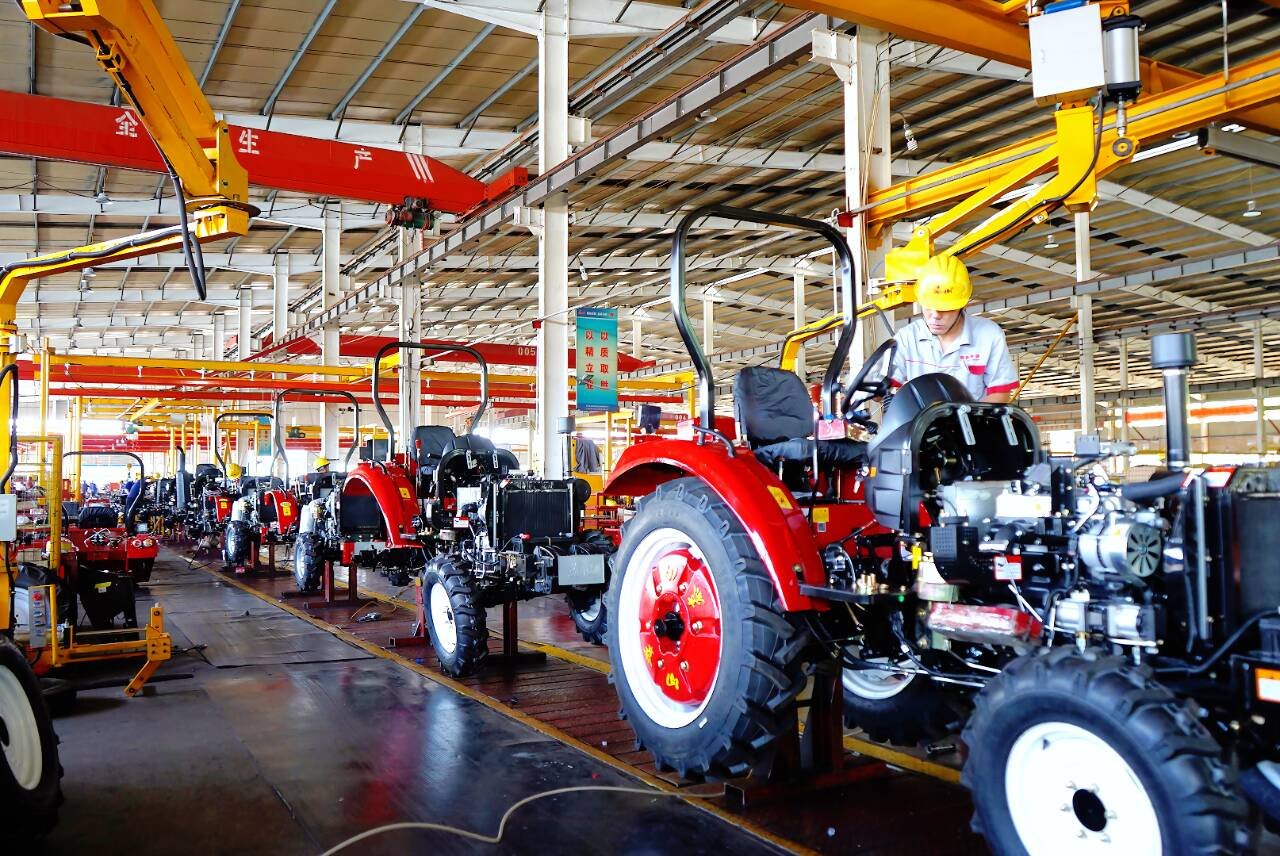
- Final Assembly Area: Uses overhead conveyor line or ground conveyor line to transport the frame to each final assembly station in sequence to complete the assembly of engine, gearbox, wheels and other components.
- Commissioning and Testing Area: Sets up professional test benches, equipped with tachometers, pressure gauges, brake testers and other equipment to complete the performance testing of the whole machine.
- Finished Product Warehousing Area: Cleans the appearance of qualified tractors, pastes labels, and transports them to the finished product warehouse through AGV (Automated Guided Vehicle).
2. Core Equipment of Production Line
| Equipment Name | Application Scenario | Core Function |
|---|---|---|
| Overhead Conveyor Line | Final Assembly Area | Carries the frame to move, realizes continuous assembly of each station, improves production rhythm |
| Special Tooling Fixture | Sub-assembly Pre-installation Area | Fixes parts, ensures assembly accuracy, reduces manual operation errors |
| Hydraulic Test Bench | Commissioning and Testing Area | Tests hydraulic system pressure and leakage to ensure reliable hydraulic function |
| Engine Running-in Bench | Sub-assembly Pre-installation Area | Conducts no-load/load running-in of the engine to improve power stability |
| AGV (Automated Guided Vehicle) | Material Transportation, Finished Product Warehousing | Realizes automatic transportation of materials and finished products, reduces manual handling |
| Intelligent Tightening System | Each Assembly Station | Precisely controls bolt tightening torque to avoid faults caused by loose or over-tight bolts |
3. Production Line Control System
Adopts MES (Manufacturing Execution System) to realize the whole-process control of production. The core functions include:
- Production Plan Management: Allocates production tasks according to order requirements, monitors the production progress of each station in real time to ensure on-time delivery.
- Quality Traceability Management: Records the component batch, assembler, and test data of each tractor to achieve precise traceability of quality problems.
- Equipment Operation and Maintenance Management: Monitors the operation status of production line equipment in real time, warns of faults in advance to reduce downtime.
- Material Management: Links with the warehousing system to realize on-demand distribution of components and avoid material shortage or accumulation.
IV. Summary
The structural design of tractors focuses on the three cores of “power transmission, driving control, and operation adaptation”. The assembly process emphasizes the combination of sub-assembly pre-installation and whole-machine commissioning. The assembly line achieves efficient and accurate mass production through modular layout and intelligent equipment, ensuring the stable and reliable performance of each tractor.