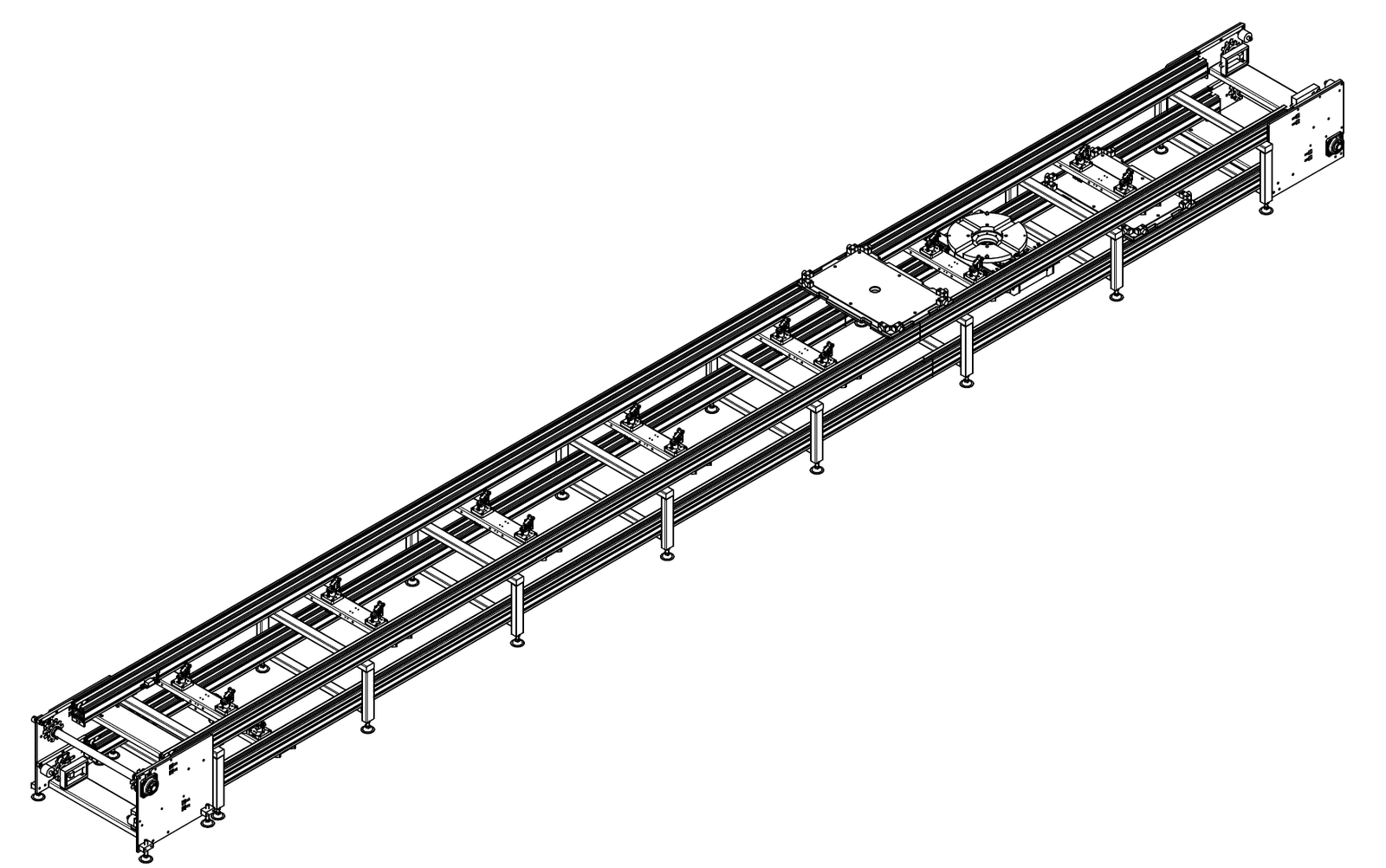
The modular free flow chain conveyor system utilizes a differential chain mechanism enabling pallets to travel at double the chain speed, ensuring efficient and flexible material handling. Featuring standardized aluminum or steel construction, variable-frequency drive systems, and configurable load capacities from 10kg to 1000kg per station, it supports diverse industrial applications including electronics assembly, automotive components, and logistics operations through customizable straight, curved, lift, and transfer modular units.
Modular Free Flow Chain Conveyor System Technical Specifications
I. System Overview
The Modular Free Flow Chain Conveyor System is an automated conveying equipment designed with standardized, modular architecture. Its core feature utilizes the Free Flow Chain (Differential Chain) transmission principle, enabling the pallet carrying workpieces to travel at 2x the chain speed, achieving efficient and flexible material handling. Widely applied in automotive components, electronics, home appliances, and logistics industries for assembly production lines.
10% chain links, 5% rollers, 1 set drive components recommended
For detailed selection calculations (torque calculation, chain tension verification, motor power validation) or 3D layout recommendations for specific applications, please provide additional operational parameters.
Application Scope and Suitable Factory Types for Free Flow Chain Conveyors
I. Core Application Fields
Free flow chain conveyor systems, characterized by accumulation conveying, flexible assembly, and efficient flow, are primarily applied in the following scenarios:
To mass-produce home appliances, synchronize assembly, test and packaging under an 18-second takt: feed big parts by conveyor, small parts by vibratory bowls; use 6-axis robots for screwing and insertion; consolidate safety, function and energy checks in one 4-in-1 station that auto-diverts failures; pack with unmanned case erectors, baggers, weigh-checkers and robot palletisers; link every…
The Importance of In-Plant Logistics Planning for SKD Production Lines – with References to Leading Global OEMs b) Cost – higher container fill and lower freight3-D stuffing simulation done at shop-floor level finds the optimum stacking angle for every SKD module, raising 40 HQ capacity by 8-12 % and directly reducing sea freight.SAIC MG India…
Passenger-car final-assembly slat conveyors are built in steel or plastic versions 600-3500 mm wide, 50-300 m long, driven by geared AC motors with VFDs giving 0.5-30 m/min stepless speed and ±30 mm stop accuracy. Plastic slats are lighter, quieter and support 30 JPH takt, while steel handles heavier loads. Lines are divided into interior, chassis…
Multi-axis Servo Tightening Machine for Hub Motors The multi-axis servo tightening machine for hub motors is a high-precision tightening device developed for the assembly scenario of new energy vehicle hub motors. Adopting multi-axis synchronous control technology, it can complete the precise tightening operation of multiple bolts of the hub motor simultaneously. The equipment integrates a…
A moving assembly line boosts e-scooter productivity and quality by splitting the vehicle into short, standardized, error-proofed stations. One-time fixture and AGV pull cut handling 90 % and line-side inventory to 4 h; parallel sub-assembly balances work at 93 % and halves takt to 45 s. Servo spindles with real-time torque curves lift first-time yield…
The general-purpose overhead conveyor line is core logistics equipment for automobile assembly, featuring three-dimensional space utilization and flexible adaptation to high-low stations. Its main types include EMS, FDS, overhead chain conveyor and T.T.S, each with distinct load capacities and application scenarios. It boasts high flexibility, stability and efficiency, adapting to multi-model mixed assembly, and will…