
1. Solution Overview
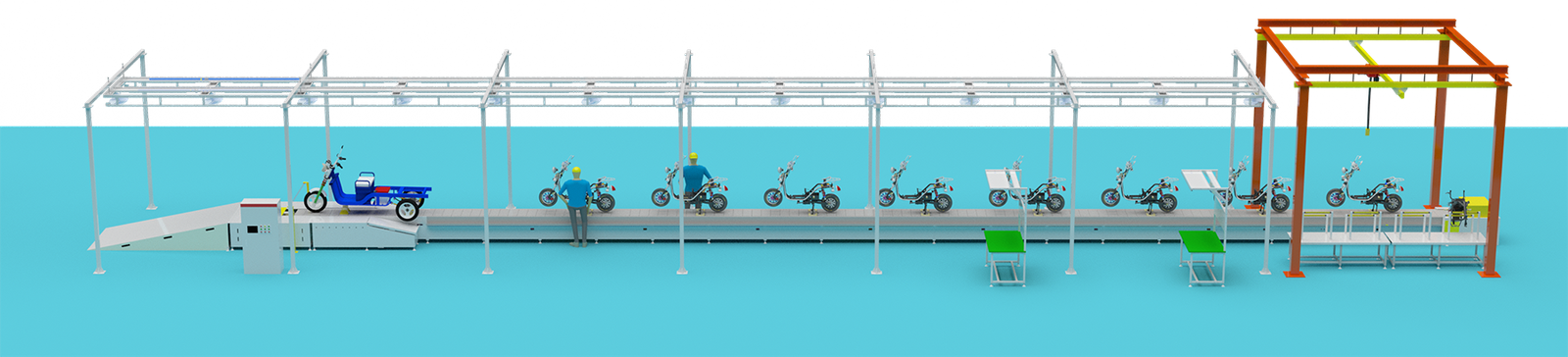
The plate chain assembly line adopts metal plate chains as the conveying carrier to realize flexible mixed-line assembly for two-wheel and three-wheel electric vehicles. Through rapid switching of station tooling and quick replacement of positioning fixtures, a single production line can support the assembly of two-wheel vehicles (electric motorcycles / electric bicycles) and three-wheel vehicles (leisure three-wheelers / cargo three-wheelers). It reduces the investment in independent production lines and is suitable for multi-model and small-to-medium batch production scenarios.
Core Features: The plate chain boasts high load capacity and strong impact resistance, which can bear the heavy weight of three-wheel vehicles. The modular tooling enables ultra-fast model switching and meets the requirements of mixed-line production.
2. Main Structure of Plate Chain Production Line
2.1 Conveying Body: Plate Chain
Adopts thickened stamped galvanized steel chain plates with flat surface and high wear resistance.
- Load Adaptability: The weight of a finished two-wheel vehicle ranges from 60kg to 120kg, while that of a three-wheel vehicle is 150kg to 350kg. The plate chain is designed with a safety load redundancy of ≥400kg per station to adapt to the weight difference between the two vehicle types.
- Driving System: Equipped with head motor and reduction mechanism as well as tail tensioning mechanism, supporting variable frequency speed regulation with an adjustable speed of 0.5–3m/min.
- Main Drive Chain: Adopts large-pitch transmission chain for stable load-bearing operation.
2.2 Rack
The rack is made of square tube welded structure with surface plastic spraying treatment. It adopts segmented modular design for convenient on-site assembly, disassembly and capacity expansion. The height of the main line is set based on ergonomics, adapting to the low frame of two-wheel vehicles and the high frame of three-wheel vehicles, with a standard station height of 550–650mm.
2.3 Station Configuration
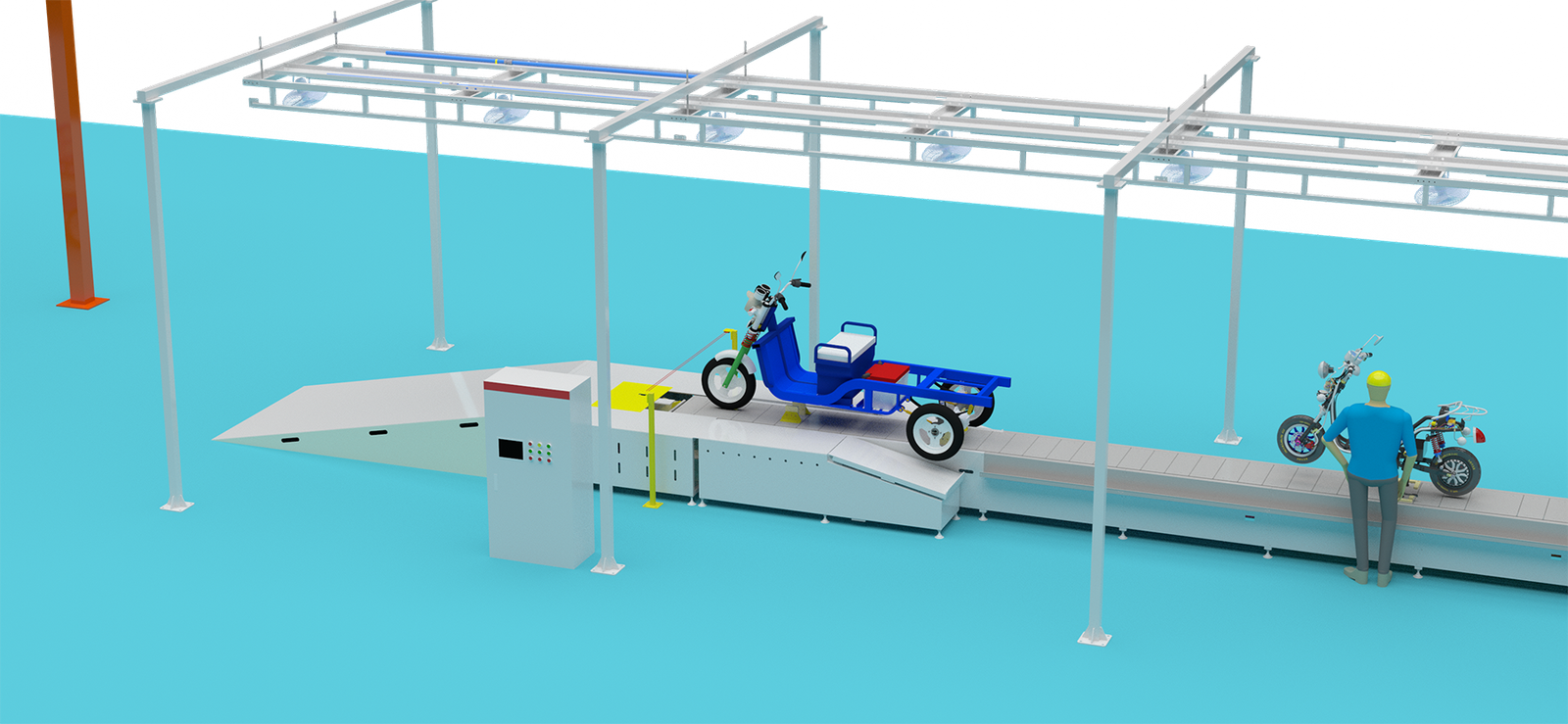
Each assembly station is equipped with pneumatic tool interfaces, power sockets, lighting systems and cooling fans to meet continuous assembly operation requirements.
- For two-wheel vehicles: Nylon limit brackets are adopted for positioning and supporting.
- For three-wheel vehicles: Widened V-shaped supporting tooling is replaced to support the main frame girder of three-wheel vehicles.
All tooling supports replaceable modular design, requiring no modification to the main plate chain line during model switching.
3. Technological Process (Universal for Mixed-line Production)
The overall process is applicable to both vehicle types, and the differences in production only lie in station tooling replacement and supporting material accessories.
- Pre-assembly preparation
- Frame feeding and tooling positioning
- Main assembly operation
- Process inspection and debugging
- Finished product offline
- Overall appearance re-inspection
The plate chain adopts a closed-loop circulating structure, and the tooling circulates and returns with the plate chain. Two-wheel and three-wheel vehicles are produced in batches according to production scheduling.
4. Auxiliary Supporting System
- Material Supply (Optional): Material racks with fluent strips and hanging material boxes are arranged on both sides of the main line. Cantilever cranes and power-assisted manipulators are configured for heavy parts such as motors, batteries and rear axles to reduce manual labor intensity.
- Torque Tool Network: Each station is equipped with constant-torque electric wrenches with data storage function to avoid missing tightening and unqualified torque values. Independent torque parameter formulas are set for two-wheel and three-wheel vehicles respectively.
- Electric Control and Emergency Stop System: The whole line is divided into multiple emergency stop sections with plate chain overload protection. Photoelectric sensors at the offline station can automatically identify in-place workpieces and trigger corresponding actions.
- Tooling Circulation System: Tooling accessories circulate and return through the return section at the bottom of the plate chain to realize recycled use.
5. Key Design Points and Difficulties of Mixed-line Production
- Center of Gravity Difference: The finished three-wheel vehicle has a wider and rearward offset center of gravity, requiring widened and stable supporting tooling to prevent tilting during conveying.
- Wheelbase Difference: The standard conveying spacing is 2.4m for two-wheel vehicles and 3.6m for three-wheel vehicles, adapting to different frame lengths.
- Load Fluctuation Adaptation: The plate chain is designed based on the maximum load of three-wheel vehicles rather than the light load of two-wheel vehicles, effectively preventing chain plate deformation and chain elongation under long-term heavy-load operation.
- Process Differentiation Adaptation: There are differences in assembly processes between two-wheel and three-wheel vehicles. The production process is reasonably arranged to balance station tact time and ensure smooth mixed-line production.
6. Advantages and Limitations
Advantages
- One production line covers two vehicle types, saving plant space and reducing overall equipment investment compared with two independent dedicated lines.
- The plate chain conveying system operates stably with no slipping under heavy-load conditions, which is more suitable for electric vehicle assembly than belt lines.
- Modular tooling design supports rapid product iteration; only tooling replacement is required without changing the main line equipment.
- Flexible production tact, which can adjust the production ratio of two-wheel and three-wheel vehicles according to actual orders.
Limitations
- Mixed-line production requires standardized management of material scheduling and tooling switching, with higher production planning complexity than dedicated lines.
- For mass production of a single vehicle type, the production efficiency is lower than that of professional dedicated assembly lines.
7. Optional Extended Configurations
- Online code scanning and MES production data acquisition system
- Serial finished vehicle detection station (post-offline configuration)
- On-station process display screen
Regarding the manufacturing lead time: 45 working days.
Global installation services are provided for the equipment.