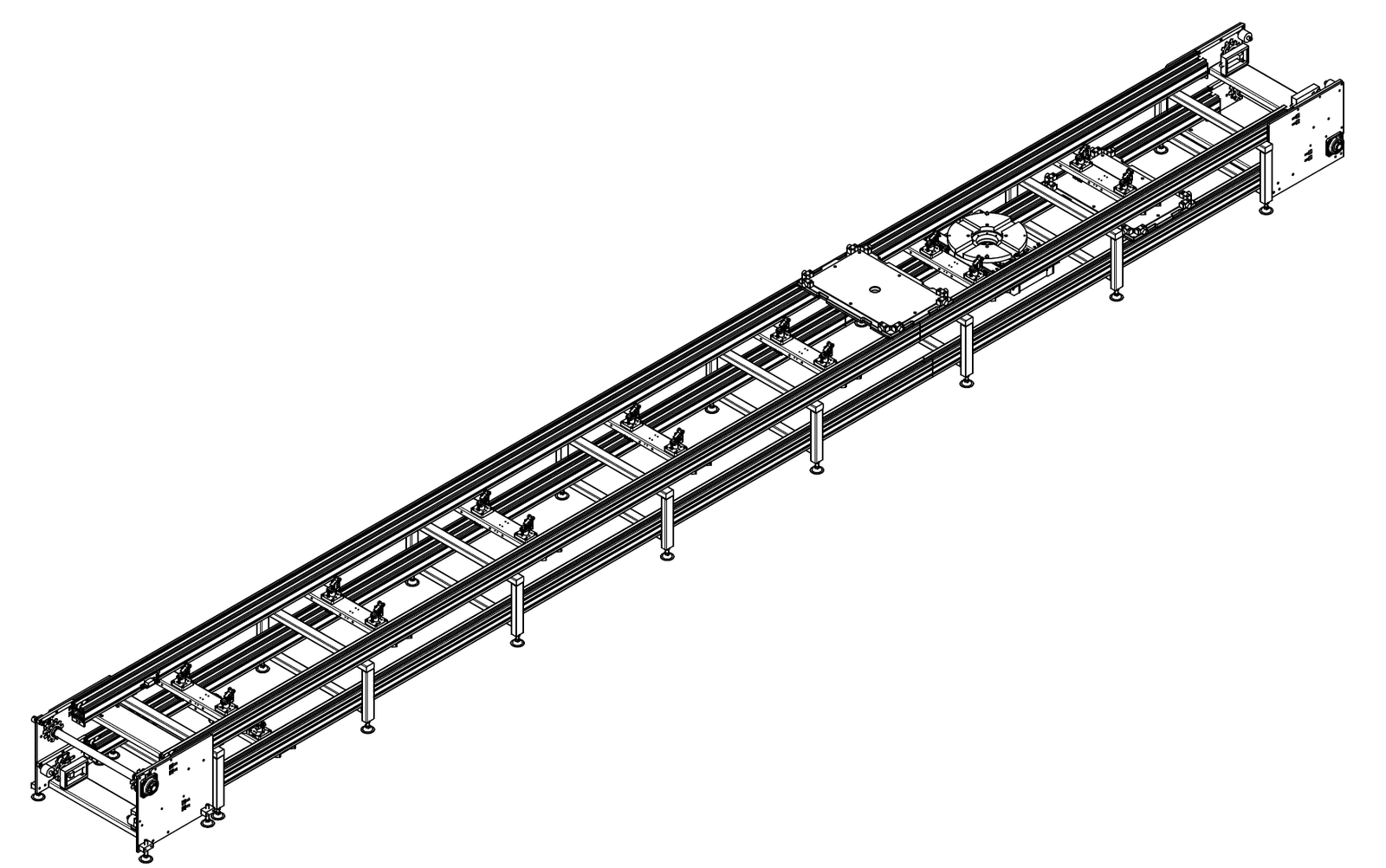
The modular free flow chain conveyor system utilizes a differential chain mechanism enabling pallets to travel at double the chain speed, ensuring efficient and flexible material handling. Featuring standardized aluminum or steel construction, variable-frequency drive systems, and configurable load capacities from 10kg to 1000kg per station, it supports diverse industrial applications including electronics assembly, automotive components, and logistics operations through customizable straight, curved, lift, and transfer modular units.
Modular Free Flow Chain Conveyor System Technical Specifications
I. System Overview
The Modular Free Flow Chain Conveyor System is an automated conveying equipment designed with standardized, modular architecture. Its core feature utilizes the Free Flow Chain (Differential Chain) transmission principle, enabling the pallet carrying workpieces to travel at 2x the chain speed, achieving efficient and flexible material handling. Widely applied in automotive components, electronics, home appliances, and logistics industries for assembly production lines.
10% chain links, 5% rollers, 1 set drive components recommended
For detailed selection calculations (torque calculation, chain tension verification, motor power validation) or 3D layout recommendations for specific applications, please provide additional operational parameters.
Application Scope and Suitable Factory Types for Free Flow Chain Conveyors
I. Core Application Fields
Free flow chain conveyor systems, characterized by accumulation conveying, flexible assembly, and efficient flow, are primarily applied in the following scenarios:
The main process flow of a lithium battery PACK production line includes the selection and matching of battery cells, the assembly of battery modules, the welding of cells, the integration of the Battery Management System (BMS), the assembly of the PACK casing, overall performance testing, and final packaging and shipment. Initially, cells are selected to…
✅ نقاط اختيار وتصميم المعدات ✅ ملاحظات التركيب والتشييد ✅ متطلبات السلامة والمعايير ✅ أمثلة التطبيق ✅ خلاصة وتوصية بالنسبة لخطوط النقل الصاعدة من الخارج إلى الداخل، النقل الوظيفي ليس كافيًا — التكيف البيئي والسلامة أمران حاسمان. أثناء مرحلة التصميم، فكّر تمامًا في:
This is a manpower allocation plan for a tractor final assembly workshop, covering rear axle, gearbox, case assembly, pre-paint line, painting, and four final assembly lines as well as the test run section. It specifies the required number of personnel for each process when the daily output is 30 units and 40 units respectively. The…
The benefits of using a production line for DC charging piles include increasing production efficiency and reducing costs while ensuring the consistency and reliability of product quality. Automated processes reduce human errors, enhance safety, and allow for quick responses to market changes and customer demands. Moreover, the modular and scaled production helps to lower unit…
✅ 1. Equipment Selection & Design Points ✅ 2. Installation & Construction Notes ✅ 3. Safety & Code Requirements ✅ 4. Application Examples ✅ Summary & Recommendation For climbing conveyors running from outdoor to indoor, functional transport is not enough—environmental adaptability and safety are critical. During the design phase, fully consider:
A moving assembly line boosts e-scooter productivity and quality by splitting the vehicle into short, standardized, error-proofed stations. One-time fixture and AGV pull cut handling 90 % and line-side inventory to 4 h; parallel sub-assembly balances work at 93 % and halves takt to 45 s. Servo spindles with real-time torque curves lift first-time yield…