
Types of conveyors used for assembly in automotive plants
Automobile factories rely on eight main types of assembly conveyors to ensure efficient and orderly production, each tailored to specific operational needs. Overhead and chain slat conveyors handle medium-heavy to heavy loads, ideal for body transfer and heavy assembly transportation. Floor slat and skid conveyors offer high positioning accuracy, supporting precision processes like chassis and engine assembly. Roller, belt, and accumulation conveyors provide flexible, cost-effective solutions for parts transfer and mixed-flow production, while AGV/AMR conveyors deliver extreme flexibility with autonomous navigation for smart factory operations. These conveyors vary in load capacity, precision, and automation levels, collectively forming a comprehensive system for automobile manufacturing.
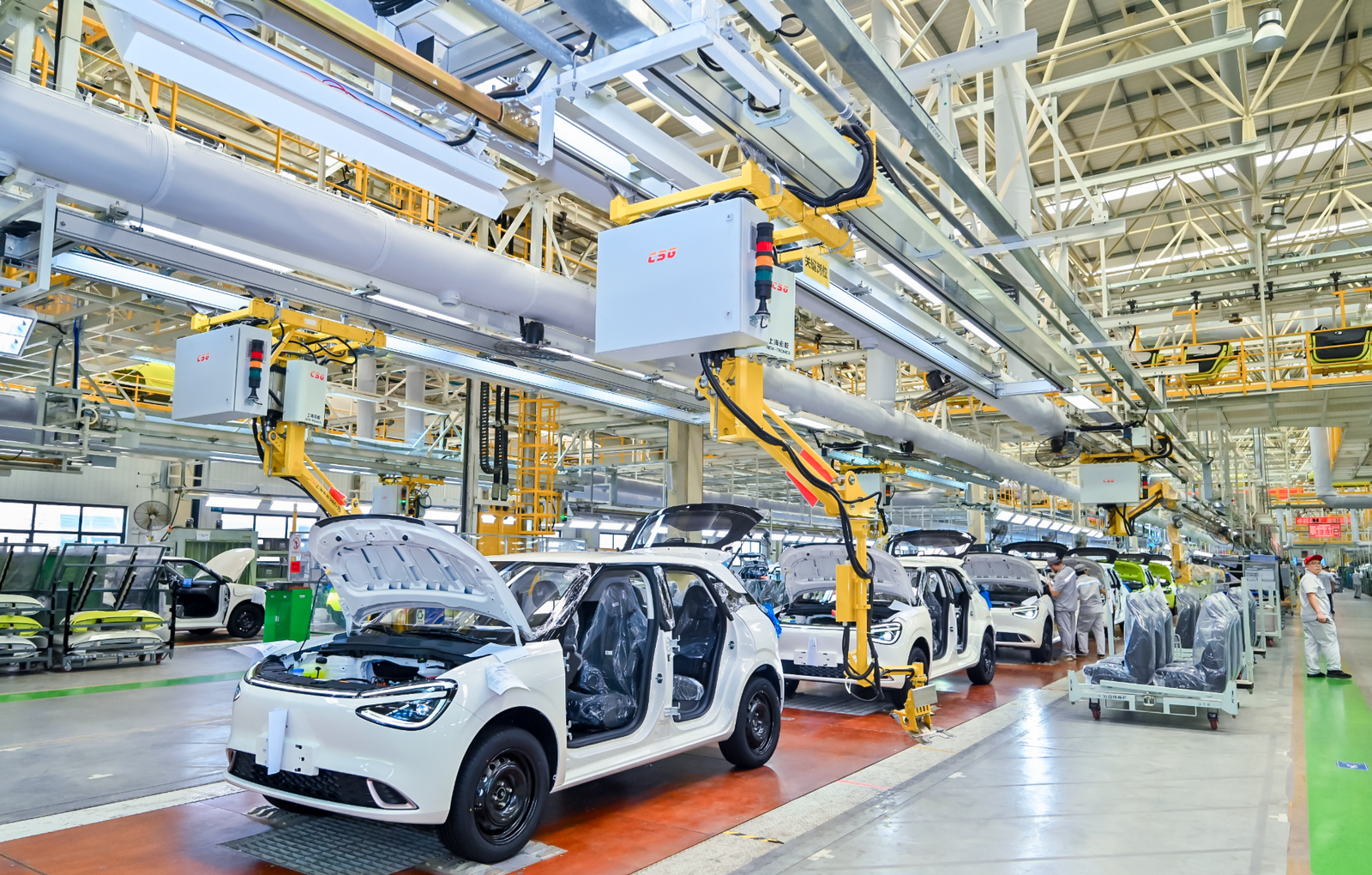
Types of Assembly Conveyors in Automobile Factories: A Detailed Explanation
Assembly conveyors are core equipment in automobile production, mainly used to transport parts and vehicle bodies between workstations, ensuring an efficient and orderly assembly process. According to the conveying method, carrying objects and process requirements, they can be mainly divided into eight categories, each with unique structural characteristics and application scenarios.
Detailed Explanation of Assembly Conveyor Types in Automobile Factories
1. Overhead Conveyor
The overhead conveyor suspends workpieces on an overhead track via spreaders for transportation. The track can be arranged in the workshop space, effectively utilizing vertical space.
- Structural Features: It consists of an overhead track, traction chain, spreader, drive device and tensioning device, and can realize various conveying paths such as straight lines, turns and lifts.
- Core Advantages: It does not occupy ground space, facilitating ground process operations; it can achieve long-distance and continuous transportation, adapting to complex workshop layouts.
- Application Scenarios: It is mainly used for the transportation of car bodies after welding, pre-treatment before painting, transfer after painting, and pre-assembly transportation of interior parts.
2. Floor Slat Conveyor
The floor slat conveyor uses a slat carrier as the core and runs on a ground track, which is one of the mainstream conveying equipment in automobile final assembly workshops.
- Structural Features: It is composed of a carrying slat, track, drive system and positioning device. The size of the carrying slat can be customized according to the vehicle model, and some models adopt a telescopic structure to adapt to vehicles with different wheelbases.
- Core Advantages: Strong load-bearing capacity, suitable for the weight of the whole vehicle; high positioning accuracy, meeting the requirements of high-precision processes such as tightening and assembly; stable operation and low noise.
- Application Scenarios: Core workstations of automobile final assembly lines, such as key processes including chassis assembly, powertrain installation and wheel assembly.
3. Roller Conveyor
The roller conveyor drives workpieces or pallets to move by the rotation of rollers, with a simple structure and strong versatility.
- Structural Features: It consists of rollers, a frame and a drive device, divided into power-driven rollers and non-powered rollers. It can be flexibly spliced into conveying paths such as straight lines and curves.
- Core Advantages: Simple structure and low maintenance cost; high conveying efficiency, enabling continuous or intermittent transportation; suitable for various carrying carriers such as pallets and bins.
- Application Scenarios: Transfer of parts from warehouses to assembly workstations, sub-assembly lines of small parts, and off-line inspection and transportation after vehicle assembly.
4. Belt Conveyor
The belt conveyor uses a belt as the carrying and traction component, suitable for continuous transportation of light materials.
- Structural Features: It is composed of a belt, rollers, a frame, a drive device and a tensioning device. The belt material can be selected from rubber, PVC, PU, etc., according to requirements.
- Core Advantages: Stable transportation, avoiding scratches on the surface of parts; low noise and low operating cost; it can realize inclined transportation to adapt to the connection of workstations at different heights.
- Application Scenarios: Transportation of small parts (such as screws, buckles and decorative panels), as well as sub-assembly lines of interior parts and electrical parts.
5. Accumulation Conveyor
The accumulation conveyor is a device that can realize automatic stacking and segmented transportation of workpieces, and can flexibly control the flow of workpieces according to workstation requirements.
- Structural Features: On the basis of ordinary conveyors, an accumulation control device is added. Through sensors and pneumatic mechanisms, it can realize the stopping and releasing of workpieces. It can be divided into overhead accumulation and ground accumulation types.
- Core Advantages: It can realize flexible connection between workstations. When a certain workstation is suspended, it will not affect the operation of the entire line; it can adapt to mixed-flow production of multiple vehicle models, improving the flexibility of the production line.
- Application Scenarios: Mixed-flow final assembly lines of multiple vehicle models, buffer transportation of parts, and assembly workstations requiring frequent start-stop operations.
6. Skid Conveyor
The skid conveyor uses a skid as the carrying carrier and realizes workpiece transportation through tracks and drive devices, which is an ideal choice for high-precision assembly.
- Structural Features: It is composed of a skid, track, drive system and positioning clamping device. A high-precision guiding structure is adopted between the skid and the track, with a positioning accuracy of up to ±0.1mm.
- Core Advantages: Extremely high positioning accuracy, meeting the assembly requirements of precision components such as engines and gearboxes; stable operation and low noise; it can realize automatic skid changing, adapting to multi-model production.
- Application Scenarios: Engine assembly lines, gearbox assembly lines, body joining workstations and other high-precision assembly processes.
7. Automated Guided Vehicle/Autonomous Mobile Robot (AGV/AMR) Conveyor
The AGV/AMR conveyor is a flexible conveying equipment that realizes trackless autonomous operation through automatic guidance technology, and is the core equipment of smart factories.
- Structural Features: It is divided into AGV (Automated Guided Vehicle) and AMR (Autonomous Mobile Robot). AGVs rely on magnetic strips, QR codes, etc., for guidance, while AMRs can achieve autonomous navigation through lidar without preset tracks.
- Core Advantages: Extremely strong flexibility, can flexibly adjust conveying paths; adapts to mixed-flow production of multiple vehicle models, and can realize one-to-one accurate distribution; reduces manual intervention and improves automation level.
- Application Scenarios: Flexible distribution of parts in the workshop, cross-regional transportation of complete vehicles, and assembly and transportation of customized vehicle models.
8. Chain Slat Conveyor
The chain slat conveyor uses a chain as the traction component, and the carrying slat is fixed on the chain, suitable for long-distance transportation of heavy materials.
- Structural Features: It is composed of a chain slat, carrying slat, track, drive device and tensioning device. The chain has high strength and strong load-bearing capacity.
- Core Advantages: Large load-bearing capacity, can transport complete vehicles and heavy assemblies; reliable operation, adapting to harsh production environments; long maintenance cycle and long service life.
- Application Scenarios: Transportation of automobile chassis assemblies, off-line transportation after vehicle assembly, and transportation of heavy workpieces in painting workshops.
Comparison Table of Automobile Assembly Conveyor Types
| Conveyor Type | Load Capacity | Positioning Accuracy | Core Advantages | Application Scenarios | Automation Level |
|---|---|---|---|---|---|
| Overhead Conveyor | Medium-Heavy | Medium | Saves ground space, flexible layout | Car body welding, painting transfer | Medium-High |
| Floor Slat Conveyor | Heavy | High | Strong load-bearing, accurate positioning, stable operation | Final assembly line core workstations, chassis assembly | High |
| Roller Conveyor | Light-Medium | Medium | Simple structure, low maintenance cost | Parts transfer, sub-assembly lines | Medium |
| Belt Conveyor | Light | Medium | Stable transportation, no scratches | Small parts sub-assembly, interior parts assembly | Medium |
| Accumulation Conveyor | Medium-Heavy | Medium | Flexible connection, adapts to mixed-flow production | Multi-model final assembly lines, workstation buffering | Medium-High |
| Skid Conveyor | Medium-Heavy | Extremely High | High positioning accuracy, suitable for precision assembly | Engine, gearbox assembly | High |
| AGV/AMR Conveyor | Light-Heavy | High | Extremely flexible, autonomous navigation | Flexible parts distribution, cross-regional transportation | Extremely High |
| Chain Slat Conveyor | Heavy | Medium | Large load-bearing, high reliability | Heavy assembly transportation, vehicle off-line | Medium-High |