Factory assembly production line for two-wheeled and three-wheeled electric vehicles
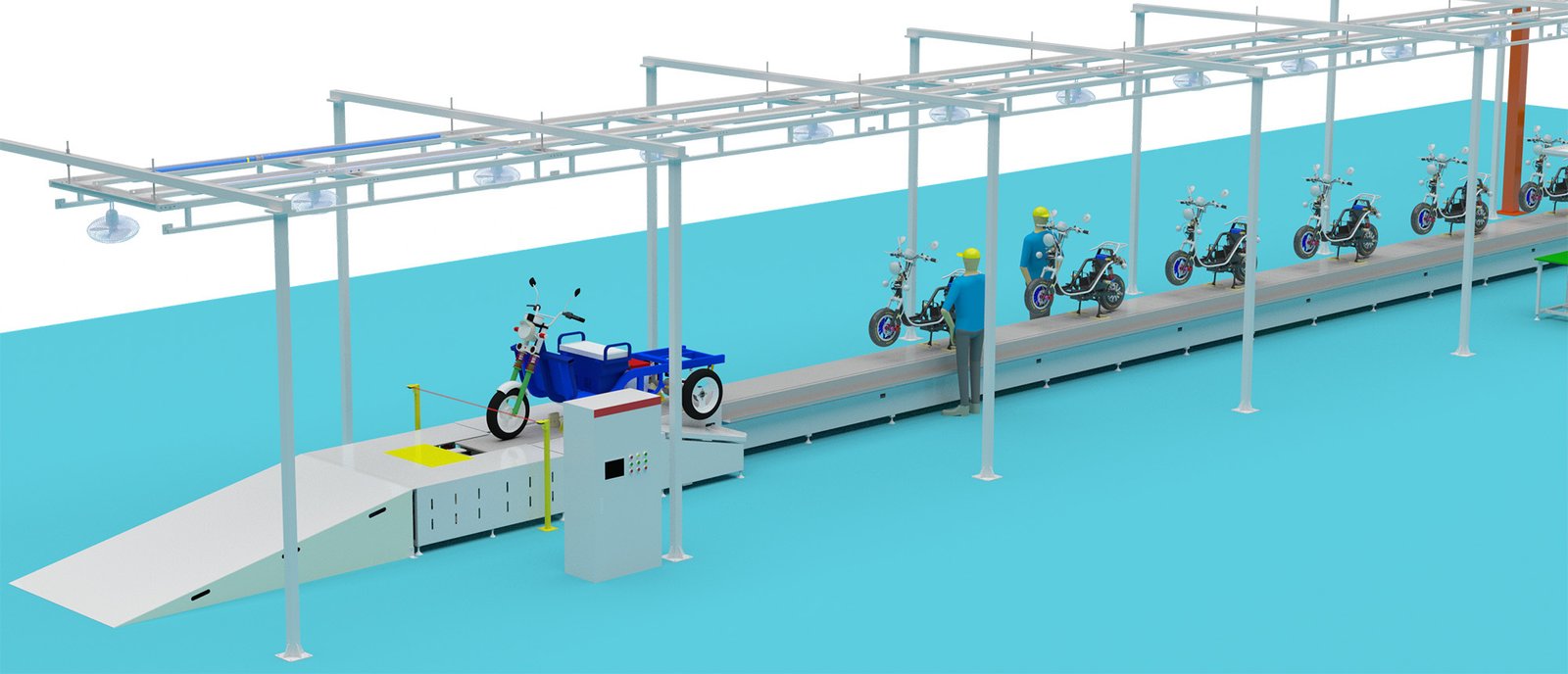
Assembly Production Line for Two‑Wheeled & Three‑Wheeled Electric Vehicles
Consists of pre‑component workshops and complete‑vehicle final‑assembly workshop. Two independent production lines can be adopted, or customized flexible mixed‑model production lines (solutions vary for large and small manufacturers).
1. Overall Workshop Layout (Modular)
- Pre‑component Workshop (Separated from Final Assembly)
- Frame Workshop: Pipe cutting, CNC tube bending, robotic welding, frame coding, electrophoretic coating / paint baking
- Motor / hub sub‑assembly line, wire harness workshop (wire cutting, terminal crimping, wire harness testing), battery PACK sub‑assembly line (lithium‑ion battery)
- Final‑Assembly Workshop (Core slat‑chain / overhead conveyor line)
- Loading station → Chassis sub‑assembly area → Electrical assembly area → Plastic exterior part / cargo box / cockpit assembly → Complete‑vehicle inspection → Off‑line, water‑spray test, road test, packaging and warehousing
2. Process Flow of Two‑Wheeled Electric Vehicle Final Assembly (Scooter / New‑National‑Standard E‑bike)
- Frame loading & inverted‑mount station: Fix the frame; install swingarm, rear shock absorber, rear‑wheel hub motor and brakes
- Flip & upright conversion: Install front fork, front shock absorber, front wheel and handlebar assembly (instrument panel, switches, headlight)
- Wire harness routing: Main harness, controller, DC‑DC converter and BMS wiring; ESD anti‑static operation
- Battery installation: Seat‑cavity battery / bottom‑mounted battery, fastening and connector locking
- Exterior parts assembly: Housing, footrest, seat cushion, rear‑view mirrors and lamps
- Power‑on complete‑vehicle test: Voltage, lights, brakes, instrument and motor functions
- Water‑spray test, braking‑performance test, chassis re‑inspection and appearance quality inspection
- Certificate printing, label sticking, off‑line and packaging
Characteristics of Two‑Wheeled Production Line
- Light‑duty slat‑chain line / overhead hanger. Fast tact time: 40‑60 seconds per unit for large factories; 6‑10 minutes per unit for small‑and‑medium factories.
- Light‑weight tooling, suitable for small‑size plastic‑body vehicles.
- Key control items: Wire‑harness error‑proofing, battery connector safety and bolt torque of braking system.
3. Process Flow of Three‑Wheeled Electric Vehicle Final Assembly (Cargo tri‑wheel / semi‑enclosed / fully‑enclosed cabin vehicle)
- Chassis loading: Assemble frame, rear‑axle assembly, leaf spring / shock absorber, differential motor and rear‑wheel groups (major difference from two‑wheelers)
- Install front axle, front fork, front wheel and steering mechanism
- Assemble wire harness, controller, DC‑DC converter and brake oil circuit
- Install battery compartment and high‑capacity battery pack (lead‑acid battery / lithium‑ion battery)
- Assemble cargo box / carriage / sheet‑metal cockpit, vehicle doors, glass, interior trims and instrument console (cabin vehicles add doors & windows, windshield wiper and air‑conditioning units)
- Commission lights, horn, reverse alarm and braking system
- Complete‑vehicle inspection: Climbing performance, braking, steering and sealing performance
- Water‑spray test, road test, quality inspection and off‑line
Characteristics of Three‑Wheeled Production Line
- Heavy‑duty slat‑chain conveyor line with high‑load pallets (150‑350 kg). Wider line body and longer working stations.
- Additional stations for rear‑axle differential assembly, sheet‑metal cargo box and door assembly. Cabin vehicles have significantly more working procedures.
- Higher torque requirements; fasteners for heavy‑duty chassis must be tightened with torque wrenches.
- Typical tact time: 2‑5 minutes per unit.
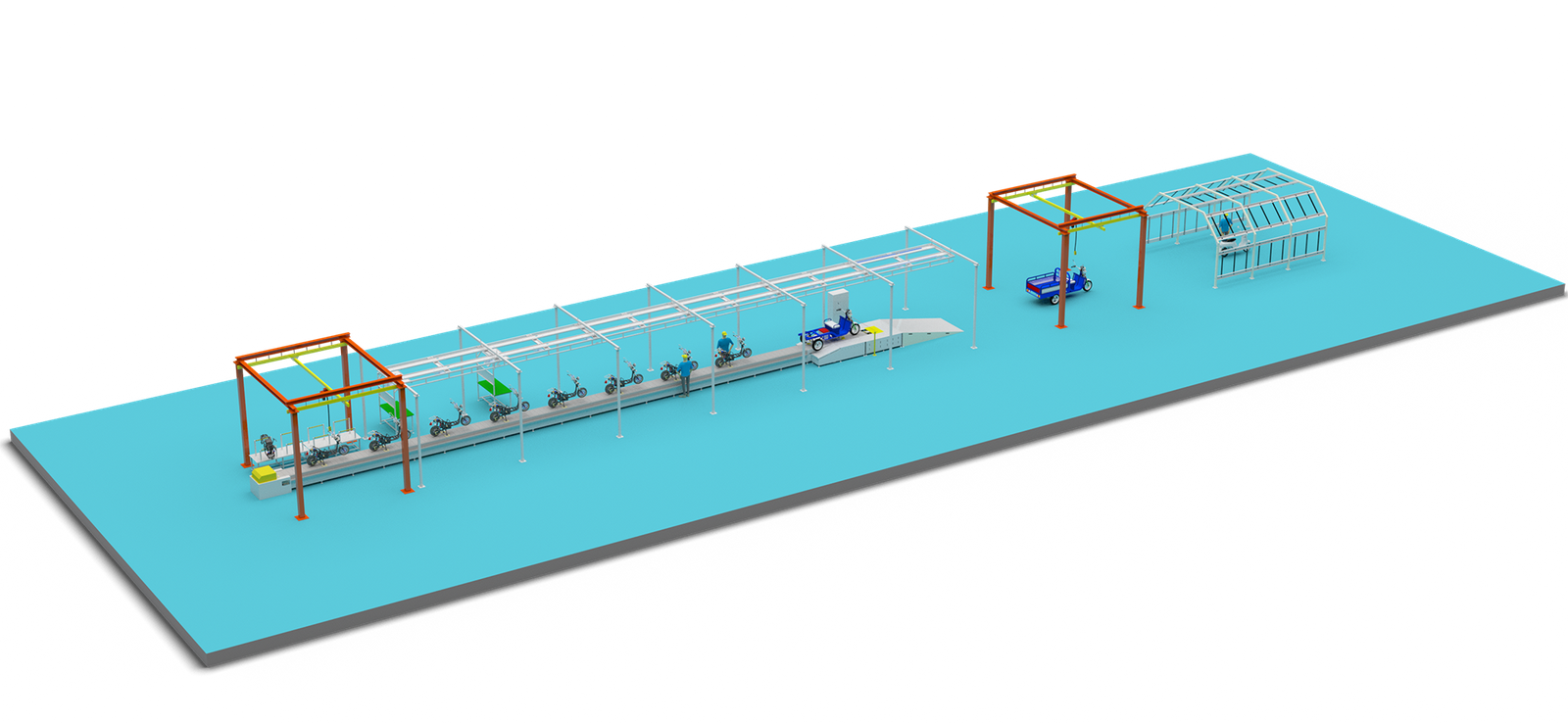
4. Core Equipment List of Production Line
Conveying Main Body
‑ Slat‑chain assembly line (most widely used), overhead accumulating conveyor, tooling pallet, lifting‑transfer machine, frame flip fixture (for inverted assembly)
Assembly Tools
‑ Pneumatic / electric torque tightening guns, torque wrenches, jib cranes, small‑size assisting manipulators (for tire and battery lifting)
Inspection‑station Equipment
‑ Complete‑vehicle electrical‑performance test bench, brake test bench, water‑spray test chamber, dynamometer, lamp detector, three‑code binding MES scanning system
Auxiliary Systems
‑ Compressed‑air piping, workstation power supply, ESD anti‑static system, side material warehouse, AGV material distribution, MES production‑management system
5. Key Comparison: Two‑Wheeled vs Three‑Wheeled Electric‑Vehicle Assembly Line
| Item | Two‑Wheeled EV Assembly Line | Three‑Wheeled EV Assembly Line |
|---|---|---|
| Conveying Load | Light‑duty, ≤100 kg | Heavy‑duty, 150‑350 kg |
| Core Assembly | Hub motor, no rear‑axle differential | Rear‑axle differential motor + leaf‑spring suspension |
| Body Assembly | Mainly plastic exterior parts | Sheet‑metal cargo box / enclosed cockpit |
| Number of Stations | 12‑20 stations | 20‑35 stations (more for cabin vehicles) |
| Floor Space | Smaller space per station | Wider line body, large material‑storage area |
| Key Risk Points | Circuit short‑circuit, battery connector | Chassis welding, rear‑axle assembly, heavy‑load braking |
6. Production‑Line Selection Schemes
- Small‑factory Scheme (Two Separate Independent Lines) ‑ Two‑wheeler: Light‑duty slat‑chain line, 15 stations, for new‑national‑standard electric bicycles ‑ Three‑wheeler: Heavy‑duty slat‑chain line, 22 stations, for open‑cargo three‑wheelers
- Medium‑sized Flexible Mixed‑model Scheme (Single line compatible with two‑wheelers & simple three‑wheelers) ‑ Replaceable tooling pallets and model‑switching programming; Not applicable for large fully‑enclosed cabin vehicles
- Large‑scale Smart Factory ‑ Robot‑aided tightening, automatic tire assembly, visual appearance inspection, full‑traceability MES system, automatic frame loading & unloading
7. Compliance & Safety Key Points
‑ Anti‑static and fire‑isolation measures are mandatory at battery‑assembly stations; lithium‑ion‑battery PACK requires separate explosion‑proof workshops. ‑ Torque traceability for critical bolts to meet 3C certification and whole‑vehicle consistency requirements. ‑ Water‑spray test, braking‑test and electrical‑safety test are mandatory factory‑release inspections. ‑ Environmental‑protection requirements for workshop: Welding‑fume treatment, coating‑exhaust‑gas treatment and hazardous‑waste management (waste batteries, waste paint).