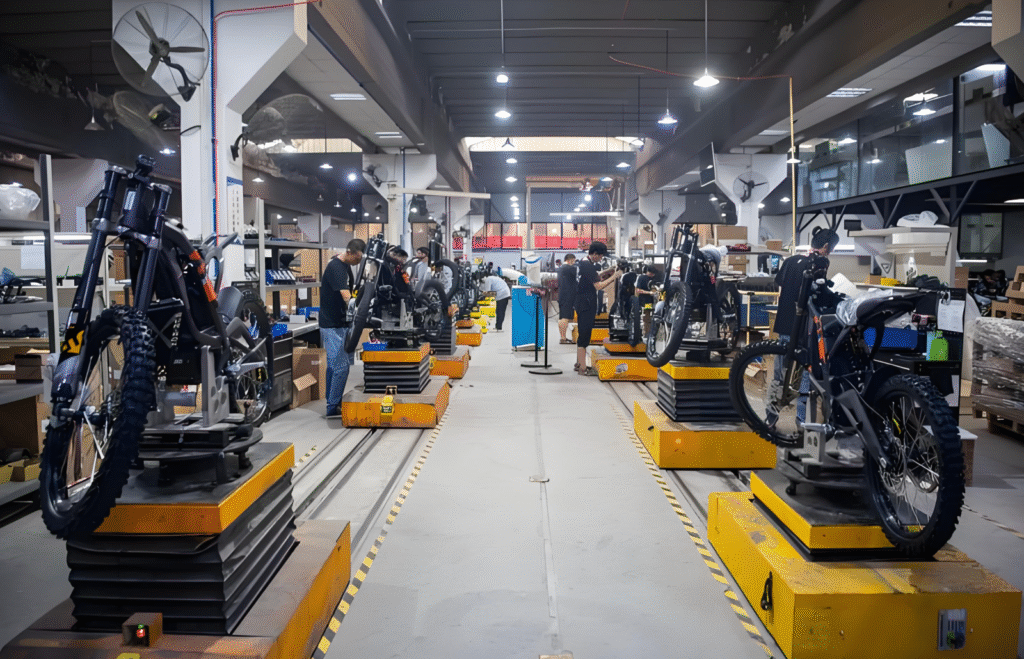
Guide to an Overview of Equipment in a Motorcycle Manufacturing Plant
A motorcycle plant integrates machining, fabrication, painting and assembly. Engine blocks/heads are milled, bored and honed on 5-axis CNC centers, then die-cast and heat-treated. Tube frames are laser-cut, CNC-bent and welded by robots before e-coat primer and 180 °C bake. Final assembly uses pallet conveyors, servo tire mounters and vacuum brake fillers, achieving 90–120 s takt. Chassis dynos, emission benches and rain chambers validate power, Euro 5 limits and leak-tightness. RFID pallets, AGVs and Andon systems drive paperless traceability and 95 % first-run yield.
Below is a complete detailed motorcycle-plant equipment list, organized by manufacturing flow.
1. Engine Machining Area
1.1 Cylinder Block / Head Line
Equipment
Core Function
Typical Configuration & Process Details
Horizontal Machining Center (HMC)
Multi-face machining in one clamping
12 000 r/min spindle, BT50 taper, 24-tool chain magazine; rough/finish milling and boring of deck face, crank bore, cam bore.
Vertical Machining Center (VMC)
End faces, angled holes, dowel holes
3- or 5-axis, automatic part flip station; finish milling of combustion chambers and ports on cylinder head.
Gun-drilling Machine
Deep oil holes
Gun drill Ø4–Ø8 mm, L/D up to 20; 7 MPa high-pressure internal coolant.
CLD NOx, NDIR CO/HC, CVS dilution; Euro 5 compliant.
Rain Test Chamber
Leak tightness
Nozzle pitch 600 mm, 10–15 mm/min rainfall, 30 min duration; floor turntable included.
6. Logistics & IT
Equipment
Core Function
Typical Configuration & Process Details
Automated Warehouse (AS/RS)
Machined blanks & parts storage
Stacker 18 m high, 2000 locations, double-deep forks; WMS real-time sync with ERP.
AGV (SLAM Navigation)
Inter-station material flow
1 t payload, ±10 mm SLAM accuracy; auto-charge and call-button integration.
Andon System
Line-side escalation
3-color tower lamp + 55″ display, trigger ≤5 s.
7. Quick Reference Table
Phase
Key Equipment
Typical Parameter / Process KPI
Engine Machining
HMC, honing, gun-drill
Ra ≤ 0.4 µm; bore tolerance H6
Frame Fab
Tube bender, welding robot
Tube thinning ≤10 %; weld penetration ≥2 mm
Paint
Pretreat, e-coat, bake
Salt spray ≥720 h; film 20–30 µm
Assembly
Pallet line, tire mounter, filler
Takt 90–120 s/unit; first-run yield ≥95 %
Testing
Dyno, emissions, rain
Speed accuracy ±0.1 km/h; 30 min rain no leak
When building a motorcycle plant anywhere on the globe, treat “climate risk” as a design input that cascades through the entire chain—building envelope, equipment, logistics and people. Below are practical notes for four representative climate zones.
Tropical Monsoon / Hot-humid (South China, SE Asia)
Typhoon & Downpour – Structure: main hall rated for ≥40 m/s wind (50-year return); roof clips upgraded; drain pipes oversized +20 %. Outdoor gantry cranes have storm anchors. – Drainage: site level ≥ +0.5 m vs. municipal road; 500 mm flood barriers; duplex power pumps in underground sump.
Corrosion & Heat – Roof and wall panels: Al-Zn alloy + PVDF, 1000 h salt-fog rating. – Ventilation: local spot-cooling at engine test stands; roof exhaust fans ≥12 air changes/h.
Equipment Choice – Electrical enclosures ≥ IP54 with internal A/C at 28 °C; CNC coolant tanks dosed with biocide to stop summer mold.
Frost Protection – Double-skin insulated wall (K ≤ 0.45 W/m²·K); inflatable dock seals and heated air curtains on loading bays. – Compressed-air dryers rated at –40 °C dew point to prevent ice in valves.
Cold-Start Support – Engine cold-test benches use 40 °C pre-heat water loops. – Wet sprinkler system replaced by dry or pre-action type.
Low Pressure – Boilers and burners derated to 0.8 atm; drying ovens retuned for altitude. – Generator room fitted with boost fans and voltage regulators to offset >15 % power loss at 3 500 m.
UV & Dust – Wall cladding with UV-resistant film; rooftop fans have sand-proof louvers. – Compressor intake filters with 50 % larger dust-holding capacity.
Human Safety – Office areas use on-site oxygen-enrichment (23 % O₂) to cut altitude sickness incidents.
Temperate Continental / Four-season (North China, US Midwest)
Large Diurnal/Seasonal Swings – Floor slabs designed with temperature joints (-20 °C to +40 °C). – Roof clerestory vents open in summer for free cooling, closed in winter for insulation.
Energy Strategy – Winter: reclaim 60 °C coolant from engine dyno for space heating—cuts gas use ~15 %. – Summer: switch to ground-source heat pumps for cooling, reducing chiller load.
Universal Playbook
Build a “climate-risk-mitigation” matrix: classify typhoon, torrential rain, blizzard, sandstorm and extreme temperature as Tier-1 risks with dedicated SOPs.
Modular critical equipment: A/C units, cooling towers and compressor stations built as containerized skids that can be crane-lifted to safety within 72 h.
Closed-loop operations: MES continuously logs ambient data (T, RH, wind, pressure) and triggers automatic protective actions to eliminate sudden shutdowns.
By combining a regional climate database, modular design and dynamic O&M, a motorcycle plant can be rapidly replicated, safely commissioned and reliably operated in any climate zone on earth.
A moving assembly line boosts e-scooter productivity and quality by splitting the vehicle into short, standardized, error-proofed stations. One-time fixture and AGV pull cut handling 90 % and line-side inventory to 4 h; parallel sub-assembly balances work at 93 % and halves takt to 45 s. Servo spindles with real-time torque curves lift first-time yield…
Motorcycle Final Assembly – Detailed Standard Operating Procedure (SOP)Scope: ≤250 cc two-wheel street/dirt motorcycles, 90 s takt, 120 k units/year two-shift Station #10 – Frame Loading1.1 Action: Lift frame onto pallet with electric hoist, align locating pins.1.2 Scan VIN and verify engraving depth ≥0.2 mm, no broken strokes. Station #20 – Engine Pre-assembly2.1 Lift engine…
Electric scooter assembly lines significantly enhance production efficiency and product quality through automation and standardized operations. They reduce costs by minimizing human errors, material waste, and production cycles, while improving safety and flexibility in the manufacturing process. Additionally, assembly lines facilitate quality monitoring and data tracking, providing robust support for continuous improvement in production processes….
✅ نقاط اختيار وتصميم المعدات ✅ ملاحظات التركيب والتشييد ✅ متطلبات السلامة والمعايير ✅ أمثلة التطبيق ✅ خلاصة وتوصية بالنسبة لخطوط النقل الصاعدة من الخارج إلى الداخل، النقل الوظيفي ليس كافيًا — التكيف البيئي والسلامة أمران حاسمان. أثناء مرحلة التصميم، فكّر تمامًا في:
Electric motorcycle assembly efficiency requires blending Lean Manufacturing’s waste elimination and quality-built-in philosophy with Assembly Line’s standardized takt and automation. This integration—termed “Lean Line”—combines continuous flow, error-proofing, and JIT pull systems with balanced workstations and intelligent logistics. The result delivers superior productivity, minimal inventory, high first-pass yield, and flexibility to handle diverse models, making it…
A well-planned workshop layout offers numerous benefits to assembly lines and production efficiency. It ensures smooth material flow, reducing waste and idle time. Proper spacing between workstations prevents bottlenecks, enhancing the overall output. Adequate height clearance facilitates the use of overhead cranes and automated storage systems, improving material handling. The layout also considers safety, providing…